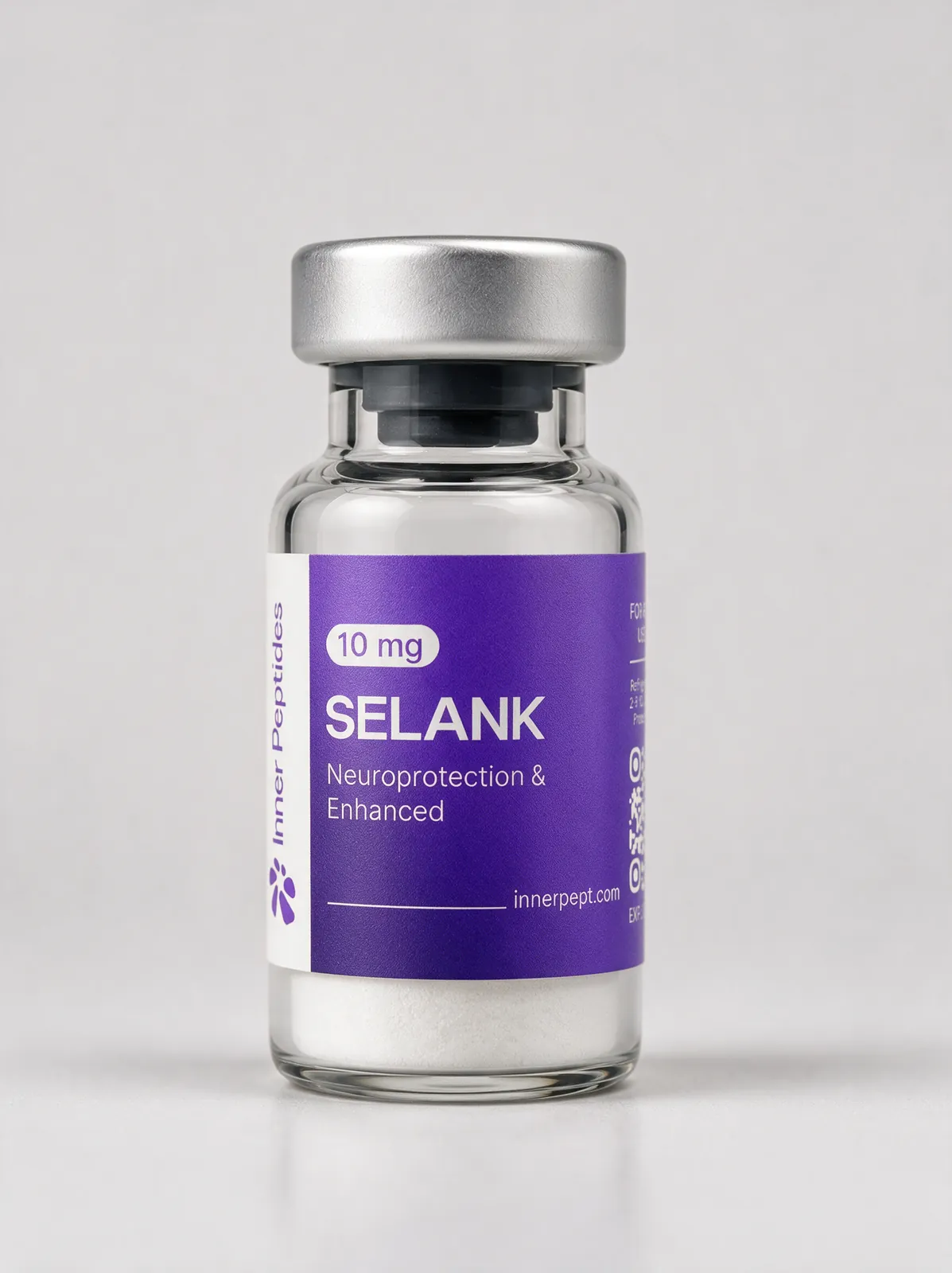

Semax
Under study for its role in attention and brain care.
Vial content, not a dose.
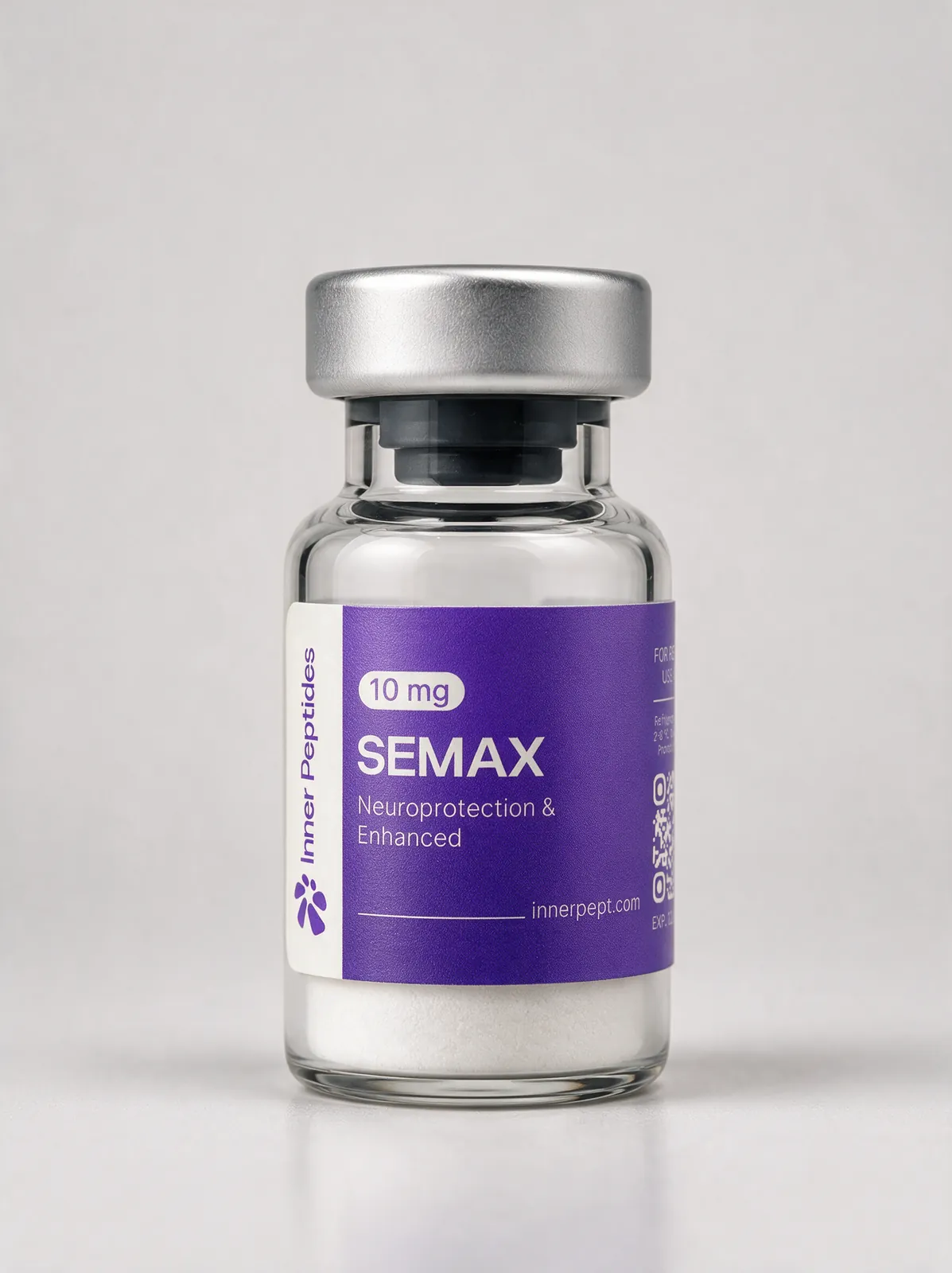
Semax is a small lab-made peptide, similar to a tiny piece of a hormone your body already makes. It was developed in Russia and is being studied for its connection to the brain: focus, attention, and the care of nerve cells. It's not a stimulant.
How it might help you.
Semax is of interest to women 35+ who notice that focus, mental stamina, or the ease of holding attention has shifted alongside hormonal and metabolic change. It suits those who would rather support the brain's own maintenance signaling than reach for a stimulant, and who want the state of the evidence described plainly before deciding.
The figures above are the amount of lyophilized peptide in the vial — they are not a dose. Your protocol, timing, and duration are set one-to-one with a licensed practitioner based on your history and goals.
The technical details, if you're curious.
Everything below is optional: the science behind this product, for anyone who wants to read it.
What it is, in detail
Semax is a synthetic heptapeptide — seven amino acids, Met-Glu-His-Phe-Pro-Gly-Pro — built as an analog of a short interior fragment of ACTH, the ACTH(4-7) sequence, rather than the full hormone. A Pro-Gly-Pro tail was added to the end to make the molecule more stable. It was developed at the Institute of Molecular Genetics in Russia, where it has been studied in relation to cognition and attention, and in the context of ischemic stroke recovery and optic-nerve conditions.
BDNF is not a foreign input. It is the brain's own maintenance signal — the one governing how neurons are held, adapted, and repaired. Semax is studied for its role in raising that signal rather than substituting for it. Nothing new is being taught here. The research question is whether a conversation the brain already knows how to have can be made audible again.
How it works inside the body
Semax descends from a fragment of a hormone the body already produces. What the research describes is a signaling route — structural stability first, then neurotrophic and dopaminergic effects downstream.
- Stabilized ACTH(4-7) core. The active sequence is a short interior fragment of ACTH. A Pro-Gly-Pro tail stabilizes that fragment, and this structural change is what distinguishes Semax from the fragment alone.
- BDNF upregulation. Research describes upregulation of brain-derived neurotrophic factor, the growth factor the brain relies on to maintain neurons and support plasticity — the signaling most associated with adaptation.
- Dopaminergic sensitization. Alongside BDNF, Semax is described as sensitizing dopaminergic signaling: not supplying dopamine, but changing how responsive that existing system is to the signal already present.
- Neuroprotection in ischemia. In experimental models of ischemia — tissue under restricted blood flow — Semax showed neuroprotective activity, which is the origin of the stroke-recovery research that followed.
What the research looks at
- Is studied for its role in upregulating BDNF, the neurotrophic signal involved in how neurons are maintained, adapted, and repaired over time.
- May support dopaminergic signaling by increasing the responsiveness of a system already present, rather than acting as a stimulant layered on top of it.
- Has been explored in research on cognition and attention, where the interest sits in signaling rather than in short-term arousal.
- Is being studied for neuroprotective activity, first observed in ischemia models and carried forward into clinical research on stroke recovery.
- Built on a fragment sequence the body already produces, stabilized so that the signal has time to be read.
Where the research stands
Semax has been studied in humans, which is more than can be said for many peptides — but most of that literature is Russian-language, and independent Western replication remains limited. The clearest signal is in stroke recovery; the cognition and attention research is thinner. The evidence is uneven, and it is uneven in a specific direction worth knowing about before you decide.
Technical specifications
Storage & handling
Before you start.
We don't publish a route, an amount, or a schedule for Semax. The 10 mg on this page refers to vial content, never a dose. How the peptide is prepared and used is settled with a licensed practitioner during consultation, against your history and whatever is already part of your care.
We don't attach a timeline to it. Neurotrophic signaling is a slow variable, individual baselines differ, and the honest answer is that no one can promise you a date. Your practitioner can name the markers that matter in your case and decide when to look at them again.
Yes. This belongs in a supervised protocol rather than a self-directed one, with a licensed practitioner who can read your health history, sequence it against anything else you're taking, and confirm whether it fits your goals before any protocol is defined. This is not a compound to self-direct.
No. The mechanism described in the research is neurotrophic and dopaminergic — BDNF upregulation and increased responsiveness of a dopamine system already in place — rather than direct stimulation. That distinction matters here: the interest is in supporting a signal the brain already runs, not in overriding it with an external push.
Semax was developed at a Russian institute, and the clinical research followed there, which is why much of the literature sits outside English-language journals. That doesn't invalidate it, but it does mean independent replication elsewhere is limited. We'd rather say so plainly than present the evidence base as broader than it is.
Every Inner Peptides formula is independently tested before it ships, with a Certificate of Analysis available whenever you ask for it. Learn more about our testing standard.