

GLOW
Three peptides being studied for skin and its repair.
Vial content, not a dose.
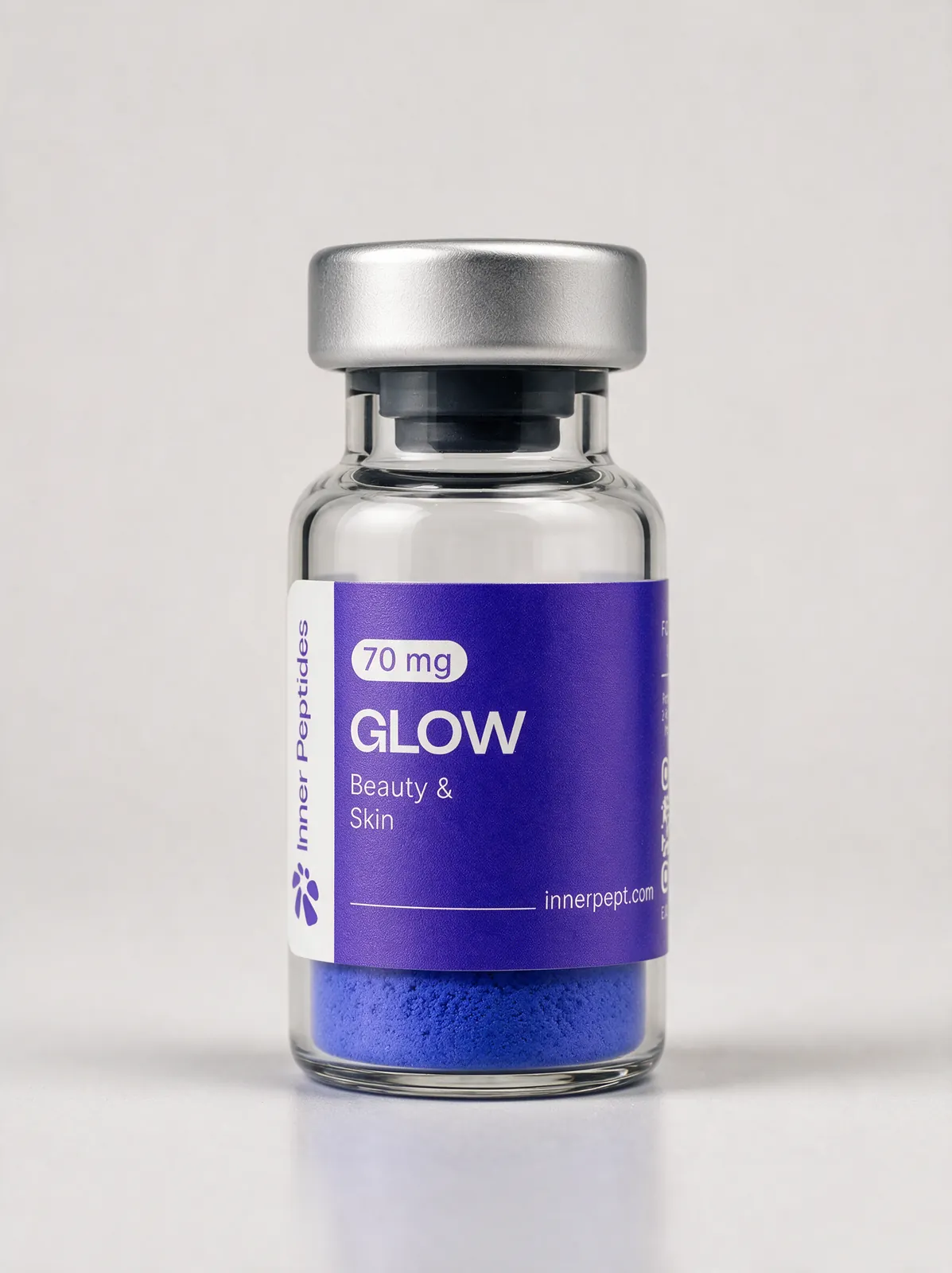
GLOW combines three peptides in one vial: GHK-Cu, BPC-157, and TB-500. All three are being studied for their role in how the body repairs skin and other tissues. Each has been researched on its own, but the blend of all three hasn't been studied yet.
How it might help you.
GLOW is oriented toward women 35 and older who are thinking about skin structure and tissue repair together — where collagen turnover, recovery from strain, and matrix quality all seem to have slowed at once. It suits readers who want to understand what each component is doing, and who accept that the evidence here is early.
The figures above are the amount of lyophilized peptide in the vial — they are not a dose. Your protocol, timing, and duration are set one-to-one with a licensed practitioner based on your history and goals.
What's actually in the vial.
This is a blended formula: each figure is that component's share of the vial.
The technical details, if you're curious.
Everything below is optional: the science behind this product, for anyone who wants to read it.
What it is, in detail
GLOW is a single-vial lyophilized blend of three peptides: GHK-Cu, a copper-binding tripeptide naturally present in human plasma; BPC-157, a fifteen-amino-acid sequence derived from a protein found in human gastric juice; and TB-500, a short fragment reproducing the actin-binding region of thymosin beta-4. Each component has been studied separately for its part in tissue repair signaling. Reconstituted, the copper content gives the solution its characteristic blue cast.
GHK-Cu is not borrowed chemistry — it circulates in human plasma, and thymosin beta-4, the parent of TB-500, sits inside most human cells. The instructions for building matrix, opening blood supply, and moving cells into place are already written. GLOW's premise is that these three signals arrive together rather than one at a time. That premise is reasoning about mechanism, not a finding — the combination itself has not been studied.
How it works inside the body
GLOW combines three peptides that act on different points of the same repair sequence — matrix construction, blood-vessel signaling, and cell movement. Each has its own molecular target; none of them supplies the tissue itself.
- Copper-matrix activation. GHK-Cu carries copper(II) coordinated by its histidine residue and terminal amino group. In research models this tripeptide is linked to collagen and elastin synthesis and extracellular-matrix remodeling.
- Angiogenic signaling. BPC-157 is studied in animal models through nitric-oxide signaling and the VEGFR2–Akt–eNOS and FAK–paxillin pathways — routes associated with new blood-vessel formation and cytoprotection in stressed tissue.
- Actin regulation. TB-500 reproduces the actin-binding region of thymosin beta-4, the actin-sequestering protein found in most human cells. Research links it to cell migration via Akt/mTOR and VEGF/angiopoietin-1 upregulation.
- Combined rationale. Matrix, vasculature, and cell movement are sequential requirements of repair, which is the rationale for combining them. That rationale is mechanistic; the combination itself has not been studied.
What the research looks at
- Combines three peptides studied separately for their roles in tissue repair — matrix building, vascular signaling, and cell migration — rather than isolating a single pathway.
- GHK-Cu is studied for its role in collagen and elastin synthesis and in extracellular-matrix remodeling, largely in laboratory and topical models.
- BPC-157 is being studied in animal models for cytoprotective and angiogenic signaling, including the nitric-oxide and VEGFR2–Akt–eNOS routes involved in blood-vessel formation.
- TB-500 is explored in animal wound-healing research for actin-dependent cell migration and reduced fibrosis, working through the same actin-binding region as its parent protein.
- May be considered within a practitioner-built regeneration protocol rather than on its own, since the blend's rationale is mechanistic rather than demonstrated.
Where the research stands
No peer-reviewed study has evaluated this three-peptide combination as a formulation. The evidence sits at the component level and is largely preclinical: BPC-157 and TB-500 rest on animal work, and a 2025 systematic review of BPC-157 in sports medicine screened 544 articles and found almost none were clinical. GHK-Cu's strongest human data are topical, not systemic.
Technical specifications
Storage & handling
Before you start.
We don't publish a route or a protocol for GLOW. The 70 mg figure describes what's in the vial, not what anyone takes. Reconstitution, route, and quantity are decided with a licensed practitioner who has reviewed your history first.
No window goes on this page, because none of the research supports one. The honest reason is that this combination has never been studied as a combination, so there is no timeline to quote — only mechanism-level research on the individual peptides. We would rather you agree on what you are actually measuring with your practitioner before anything starts.
Yes. GLOW should only be considered under a licensed practitioner who can review your health history, look at what else you're taking, and decide whether a three-peptide blend is a sensible starting point at all. Given how early the evidence is, that conversation matters more here than it would elsewhere in the catalog.
Because it is the component with the deepest research base — largely in vitro and topical, but deeper than either of the others carries. GHK-Cu 50 mg, BPC-157 10 mg, and TB-500 10 mg is the composition this blend is built on. Those figures are vial content, not doses, and the ratio is a formulation choice rather than a studied one.
GHK-Cu on its own addresses one part of repair — the matrix. GLOW adds two peptides studied for the steps around it: vascular signaling and cell migration. The trade-off is honest to state: GHK-Cu has the deeper research base, including topical dermatology work, while the blend's case is mechanistic reasoning rather than study.
Every Inner Peptides formula is independently tested before it ships, with a Certificate of Analysis available whenever you ask for it. Learn more about our testing standard.