
GHK-Cu
A copper peptide, studied in collagen and skin research.
Vial content, not a dose.
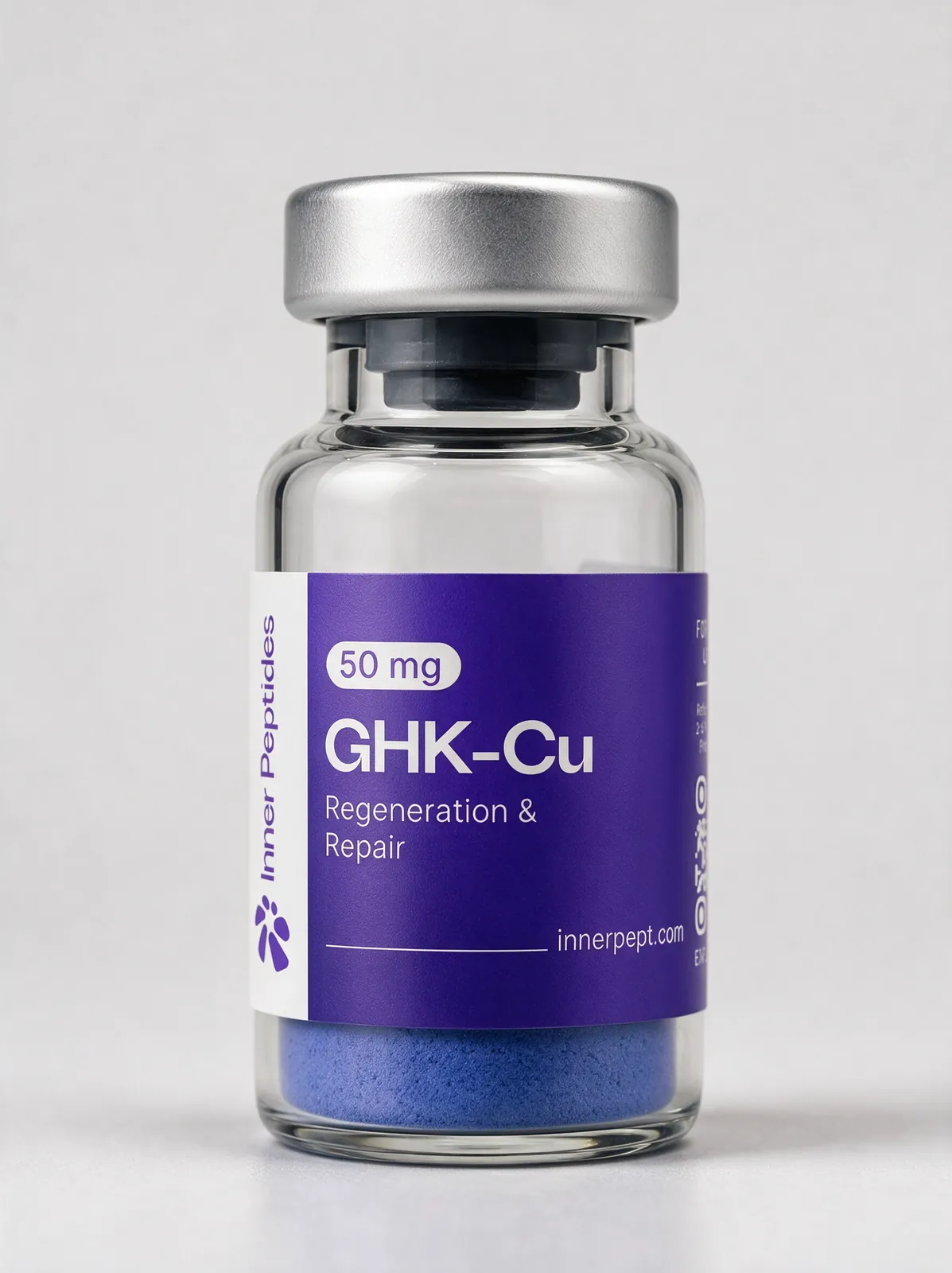
GHK-Cu is a peptide (a very small protein) bound to copper. It's found naturally in your blood. It's being researched mostly for its connection to skin: to collagen and elastin, which give skin its firmness and elasticity, and to how skin renews itself.
How it might help you.
Of interest to women 35 and older paying attention to skin structure and connective tissue — firmness, texture, how readily tissue recovers — and who want to understand the mechanism before committing to anything. Because the systemic evidence is thin, it belongs in a conversation with a licensed practitioner rather than in a self-directed routine.
The figures above are the amount of lyophilized peptide in the vial — they are not a dose. Your protocol, timing, and duration are set one-to-one with a licensed practitioner based on your history and goals.
The technical details, if you're curious.
Everything below is optional: the science behind this product, for anyone who wants to read it.
What it is, in detail
GHK-Cu is the tripeptide glycyl-L-histidyl-L-lysine — glycine, histidine, lysine — chelated to copper(II). It occurs naturally in human plasma, which makes it a signal the body already recognizes rather than a synthetic import. The copper is held in place by the histidine and the peptide's terminal amino group, a coordination that gives the solution its characteristic blue. Research interest centers on its association with the skin's structural matrix: collagen, elastin, and the ongoing renewal of the tissue beneath the surface.
GHK is not something introduced from outside — it circulates in human plasma as part of the body's own repair vocabulary. That is the premise here: not to impose a new instruction on skin or connective tissue, but to reinforce a signal the body already writes. Restoring an existing conversation rather than starting a different one.
How it works inside the body
The peptide's function is inseparable from the copper it carries. What the research describes is a chelated complex acting on the machinery of the extracellular matrix rather than on any single receptor.
- Copper coordination. Copper(II) is held by the histidine and the peptide's terminal amino group, forming a stable chelate — the reason a correctly reconstituted vial reads a distinct blue.
- Matrix protein synthesis. In vitro and topical models, GHK-Cu is studied for its influence on collagen and elastin synthesis — the two structural proteins that give dermal tissue its firmness and recoil.
- Extracellular-matrix remodeling. Research also examines its role in extracellular-matrix remodeling: the continuous turnover in which worn structural protein is cleared and replaced, rather than simply layered over.
- Angiogenic signaling. Upregulation of bFGF and VEGF is described in the literature — growth factors involved in forming the microvasculature that supplies tissue while it repairs.
What the research looks at
- Is studied, largely in vitro and in topical models, for its association with collagen and elastin synthesis in dermal tissue.
- May support the extracellular matrix's own remodeling processes rather than adding structural material from outside the body.
- Is explored for its relationship to angiogenic signaling — the bFGF and VEGF pathways involved in tissue repair.
- Research describes antioxidant and anti-inflammatory activity alongside the matrix work, though that research is largely in vitro and topical rather than systemic.
- Considered as one component of a practitioner-directed regeneration protocol, not as a standalone answer to skin or tissue concerns.
Where the research stands
We would rather be precise than flattering here. The meaningful body of work on GHK-Cu is in vitro and topical dermatological research — that is where the evidence actually sits. Systemic use has not been clinically validated, and no amount of mechanistic plausibility substitutes for that. This page treats it as preclinical because it is.
Technical specifications
Storage & handling
Before you start.
We don't publish a route, a dose, or a schedule. The 50 mg figure on this page is vial content, not a dose. Administration and protocol are settled with a licensed practitioner, based on your history and your goals.
Same molecule, different context. The strongest published evidence for GHK-Cu comes from topical and dermatological research, where it has been studied on the skin's surface. Systemic use is a separate question, and it has not been clinically validated. We'd rather you hear that from us than assume the two carry equal support.
That colour comes from the copper. GHK holds copper(II) through its histidine and its terminal amino group, and that coordination produces the characteristic blue you see in solution. It is a property of the chelated complex itself, not a dye or an additive — the peptide and the copper are not separable here.
We leave that unanswered here, deliberately. Structural tissue turns over on its own timeline, individual response varies, and most of what is known about this peptide comes from laboratory and topical work rather than from following people over months. That judgment belongs to whoever is reading your labs, not to us.
Yes. This is not a compound to self-direct. A licensed practitioner should review your health history, consider anything else already in your protocol, and confirm whether GHK-Cu fits before anything begins. Given how much of the evidence base is topical rather than systemic, that conversation matters more here, not less.
Every Inner Peptides formula is independently tested before it ships, with a Certificate of Analysis available whenever you ask for it. Learn more about our testing standard.