
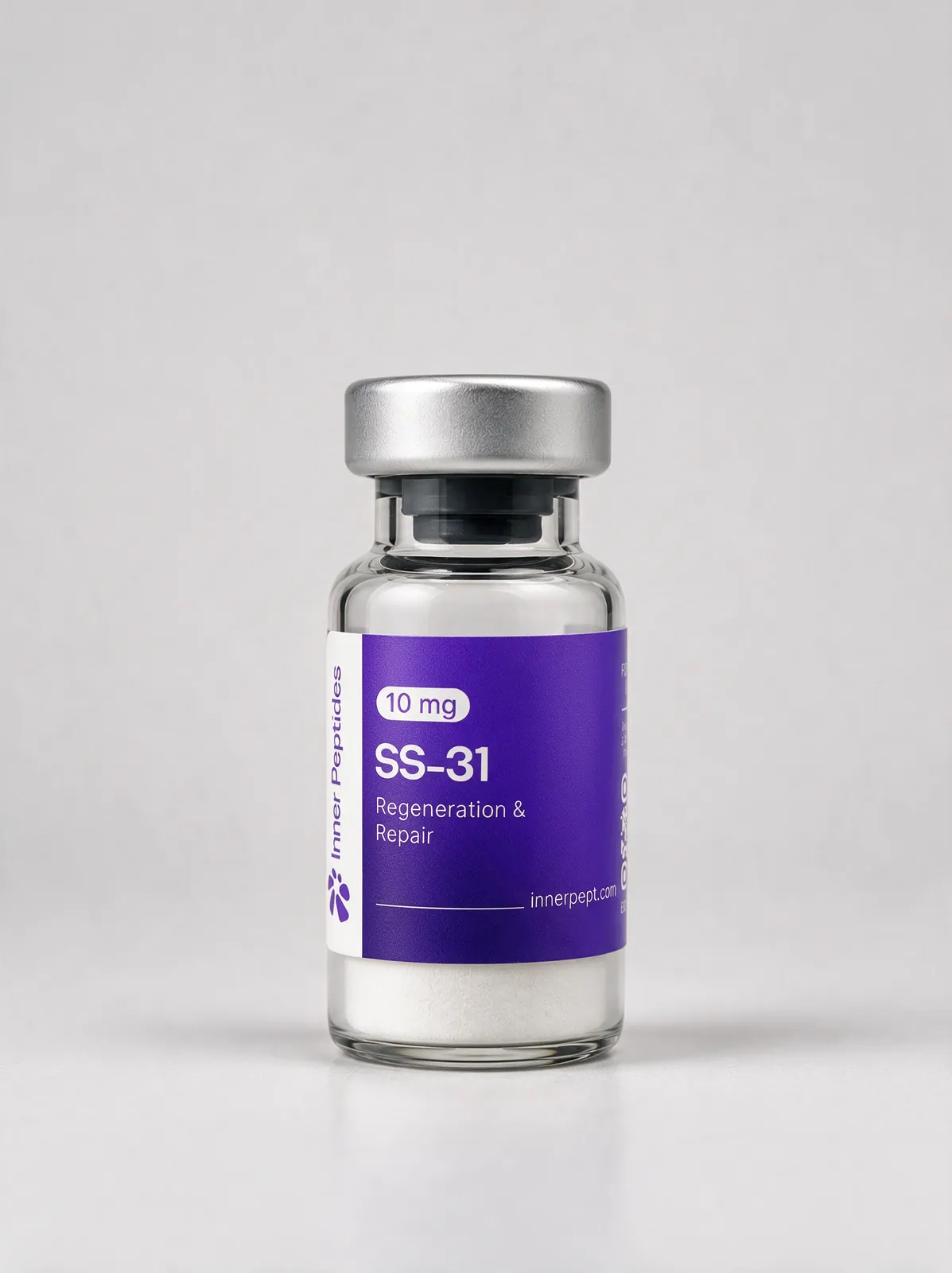
SS-31
Focused on mitochondria, the energy source of every cell.
Vial content, not a dose.
SS-31 gets into cells and concentrates in the mitochondria, the energy factories inside every cell. It's being studied because it attaches to a component that keeps the inner folds of those factories stable — the folds where energy is made. It's not a stimulant.
How it might help you.
Relevant for women 35 and older who are looking at energy, recovery, and muscular endurance from the cellular side rather than the symptomatic one. It suits those who would rather understand a mechanism before starting anything — and who are working with a practitioner on the broader metabolic and hormonal picture, not on one complaint at a time.
The figures above are the amount of lyophilized peptide in the vial — they are not a dose. Your protocol, timing, and duration are set one-to-one with a licensed practitioner based on your history and goals.
The technical details, if you're curious.
Everything below is optional: the science behind this product, for anyone who wants to read it.
What it is, in detail
SS-31, also known as elamipretide, is a cell-permeable tetrapeptide from the Szeto-Schiller family of mitochondria-targeted compounds. Rather than acting at a receptor on the cell surface, it passes into the cell and concentrates at the inner mitochondrial membrane — the folded surface where energy production actually happens. Its research profile is structural rather than hormonal: SS-31 is studied for its reversible association with cardiolipin, the lipid that gives that membrane its architecture, and for what that architecture makes possible in bioenergetic terms.
Every cell already knows how to fold its mitochondrial membranes; cardiolipin is the lipid that holds that shape in place. What can falter is not the instruction but the structure carrying it. SS-31 is studied for binding to that lipid reversibly and stabilizing what is already present — reinforcing an existing architecture rather than issuing the cell a new one.
How it works inside the body
Most peptides in this catalog speak to a receptor. SS-31 works one level deeper — inside the organelle itself, on the lipid that gives the inner mitochondrial membrane its folded structure.
- Mitochondrial targeting. SS-31 is cell-permeable and mitochondria-targeted: it crosses cell membranes without needing a surface receptor and concentrates in the inner mitochondrial membrane rather than distributing evenly through the cell.
- Cardiolipin binding. Once there, SS-31 binds reversibly to cardiolipin, the lipid that populates the inner mitochondrial membrane. Reversibly is the operative word: this is an association with an existing structure, not a permanent modification of it.
- Cristae stabilization. That binding is studied for its role in stabilizing cristae — the tight internal folds of the mitochondrial membrane that give the organelle its working surface for energy production.
- Bioenergetic output. With cristae architecture held steady, research examines improvements in mitochondrial bioenergetics: the efficiency with which the organelle converts fuel into usable cellular energy. Structure first, output second.
What the research looks at
- Is studied for its role in supporting mitochondrial bioenergetics — how efficiently cells convert fuel into usable energy — rather than acting as a stimulant.
- May support the structural integrity of the inner mitochondrial membrane, the folded surface where the cell's energy production physically takes place.
- Is being studied at a defined molecular target — cardiolipin, inside the mitochondrion — which is why its mechanism can be described specifically rather than in broad antioxidant terms.
- Is explored in research on mitochondrial myopathy, where muscle is the tissue in which mitochondrial capacity shows up most directly.
- Sits within a cellular-maintenance approach — supporting the machinery behind energy, recovery, and repair rather than addressing each of those separately.
Where the research stands
SS-31 sits at the clinical end of this catalog. Its human evidence comes from controlled study in rare inherited mitochondrial disease, alongside a separate Phase 3 program in primary mitochondrial myopathy. That evidence is real but narrow: it was built in specific disease populations, not in general wellness use.
Technical specifications
Storage & handling
Before you start.
The 10 mg on the vial is the amount of peptide contained in it — vial content, not a dose. We don't publish a dose or a schedule, because the right one depends on your history, your goals, and what else is already part of your care. That is worked out in consultation, against your labs and what else is already in place.
We don't attach a timeline to this one. Mitochondrial structure and bioenergetics operate below the level of anything you would feel on a given morning, and individual response varies considerably. We would rather you agree on what you are actually measuring with your practitioner before anything starts.
Yes. SS-31 should only be introduced under the guidance of a licensed practitioner who can review your health history, look at how it sits alongside anything else you are taking, and confirm whether it is an appropriate fit at all. That review comes first — the protocol is defined afterward, not before.
Antioxidants generally work by scavenging reactive molecules once they have already formed, wherever they encounter them. SS-31 is studied differently: it is mitochondria-targeted, concentrating at the inner membrane and associating with a specific lipid, cardiolipin. The research interest is structural — the membrane architecture itself — rather than broad chemical neutralization.
Because the mechanism is not disease-specific — cardiolipin and cristae exist in every cell — but the evidence largely is. Those studies tell us what SS-31 does at the mitochondrial membrane; they do not tell us what it does for a healthy adult. We would rather say that plainly than blur the distinction.
Every Inner Peptides formula is independently tested before it ships, with a Certificate of Analysis available whenever you ask for it. Learn more about our testing standard.