
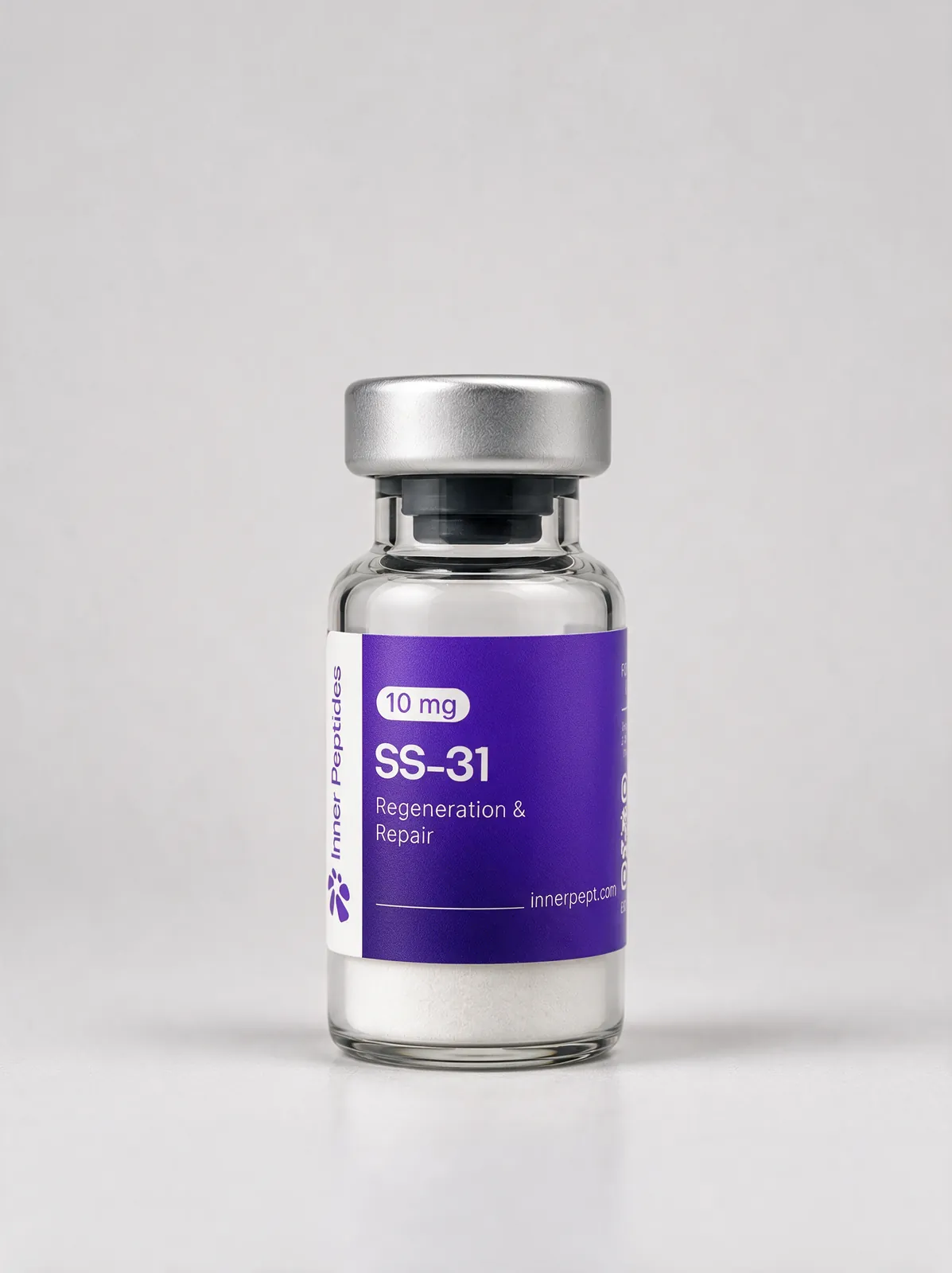
SS-31
Enfocado en las mitocondrias, la fuente de energía de cada célula.
Contenido del vial, no una dosis.
El SS-31 entra en las células y se concentra en las mitocondrias, las fábricas de energía que cada célula tiene por dentro. Se estudia porque se une a un componente que mantiene firmes los pliegues internos de esas fábricas, donde se produce la energía. No es un estimulante.
En qué te podría ayudar.
Relevante para mujeres de 35 años en adelante que miran la energía, la recuperación y la resistencia muscular desde el lado celular y no desde el síntoma. Encaja con quienes prefieren entender un mecanismo antes de empezar algo, y que trabajan con un profesional de la salud sobre el panorama hormonal y metabólico completo, no sobre una molestia a la vez.
Las cifras de arriba son la cantidad de péptido liofilizado que contiene el vial — no son una dosis. Tu protocolo, tiempos y duración se definen uno a uno con un profesional de la salud licenciado, a partir de tu historia y tus objetivos.
Los detalles técnicos, por si te interesan.
Todo lo que sigue es opcional: la ciencia detrás de este producto, para quien quiera leerla.
Qué es, en detalle
SS-31, también conocido como elamipretide, es un tetrapéptido permeable a las células, de la familia Szeto-Schiller de compuestos dirigidos a la mitocondria. En lugar de actuar sobre un receptor en la superficie celular, entra en la célula y se concentra en la membrana mitocondrial interna: la superficie plegada donde ocurre realmente la producción de energía. Su perfil de investigación es estructural más que hormonal: el SS-31 se estudia por su asociación reversible con la cardiolipina, el lípido que le da su arquitectura a esa membrana, y por lo que esa arquitectura hace posible en términos bioenergéticos.
Cada célula ya sabe cómo plegar sus membranas mitocondriales; la cardiolipina es el lípido que mantiene esa forma en su sitio. Lo que puede fallar no es la instrucción, sino la estructura que la sostiene. El SS-31 se estudia por unirse de forma reversible a ese lípido y estabilizar lo que ya está ahí: reforzar una arquitectura existente en lugar de darle a la célula una nueva.
Cómo funciona por dentro
La mayoría de los péptidos de este catálogo le hablan a un receptor. El SS-31 actúa un nivel más adentro: dentro de la propia mitocondria, sobre el lípido que le da a la membrana mitocondrial interna su estructura plegada.
- Direccionamiento mitocondrial. El SS-31 atraviesa las membranas celulares sin necesitar un receptor de superficie y se dirige a la mitocondria: se concentra en la membrana mitocondrial interna en lugar de repartirse de manera uniforme por toda la célula.
- Unión a la cardiolipina. Una vez allí, el SS-31 se une de forma reversible a la cardiolipina, el lípido que puebla la membrana mitocondrial interna. Reversible es la palabra clave: se trata de una asociación con una estructura que ya existe, no de una modificación permanente de ella.
- Estabilización de las crestas. Esa unión se estudia por su papel en la estabilización de las crestas: los pliegues internos y apretados de la membrana mitocondrial que le dan a la mitocondria su superficie de trabajo para producir energía.
- Rendimiento bioenergético. Con la arquitectura de las crestas sostenida, la investigación examina mejoras en la bioenergética mitocondrial: la eficiencia con la que la mitocondria convierte combustible en energía celular utilizable. Primero la estructura, después el rendimiento.
Lo que estudia la investigación
- Se estudia por su papel en el apoyo a la bioenergética mitocondrial — la eficiencia con la que las células convierten combustible en energía utilizable — y no por actuar como un estimulante.
- Podría apoyar la integridad estructural de la membrana mitocondrial interna, la superficie plegada donde ocurre físicamente la producción de energía de la célula.
- Se está estudiando sobre una diana molecular definida — la cardiolipina, dentro de la mitocondria — , lo que permite describir su mecanismo con precisión y no en términos antioxidantes generales.
- Se explora en investigación sobre miopatía mitocondrial, donde el músculo es el tejido en el que la capacidad mitocondrial se manifiesta de forma más directa.
- Se inscribe en un enfoque de mantenimiento celular: apoyar la maquinaria que sostiene la energía, la recuperación y la reparación, en lugar de atender cada una de esas cosas por separado.
En qué punto está la investigación
El SS-31 se ubica en el extremo clínico de este catálogo. Su evidencia en humanos proviene de un estudio controlado en una enfermedad mitocondrial hereditaria poco frecuente, junto a un programa aparte de Fase 3 en miopatía mitocondrial primaria. Esa evidencia es real, pero acotada: se construyó en poblaciones con enfermedades específicas, no en uso general de bienestar.
Ficha técnica
Conservación y manejo
Antes de empezar.
Los 10 mg del vial son la cantidad de péptido que contiene: contenido del vial, no una dosis. No publicamos dosis ni esquemas, porque el adecuado depende de tu historia, de tus objetivos y de lo que ya forma parte de tu cuidado. Eso se define en consulta, a la luz de tus análisis y de lo que ya tienes en marcha.
A este no le ponemos plazos. La estructura mitocondrial y la bioenergética operan por debajo del nivel de lo que se siente en una mañana cualquiera, y la respuesta individual varía bastante. Preferimos que definas con tu profesional de la salud qué es lo que vas a medir realmente, antes de empezar nada.
Sí. El SS-31 solo debería introducirse bajo la guía de un profesional de la salud licenciado que pueda revisar tu historia clínica, ver cómo se acomoda junto a lo demás que estés tomando y confirmar si es apropiado para ti. Esa revisión va primero: el protocolo se define después, no antes.
Los antioxidantes suelen actuar capturando moléculas reactivas una vez que ya se formaron, dondequiera que las encuentren. El SS-31 se estudia de otra manera: está dirigido a la mitocondria, se concentra en la membrana interna y se asocia con un lípido específico, la cardiolipina. El interés de la investigación es estructural — la arquitectura de la membrana en sí — y no una neutralización química amplia.
Porque el mecanismo no es específico de una enfermedad — la cardiolipina y las crestas existen en toda célula — , pero la evidencia en buena medida sí lo es. Esos estudios nos dicen qué hace el SS-31 en la membrana mitocondrial; no nos dicen qué hace en una persona adulta sana. Preferimos decirlo con claridad antes que difuminar la distinción.
Cada fórmula de Inner Peptides se analiza de forma independiente antes de enviarse, con un Certificado de Análisis disponible si lo pides. Conoce más sobre nuestro estándar de análisis.