
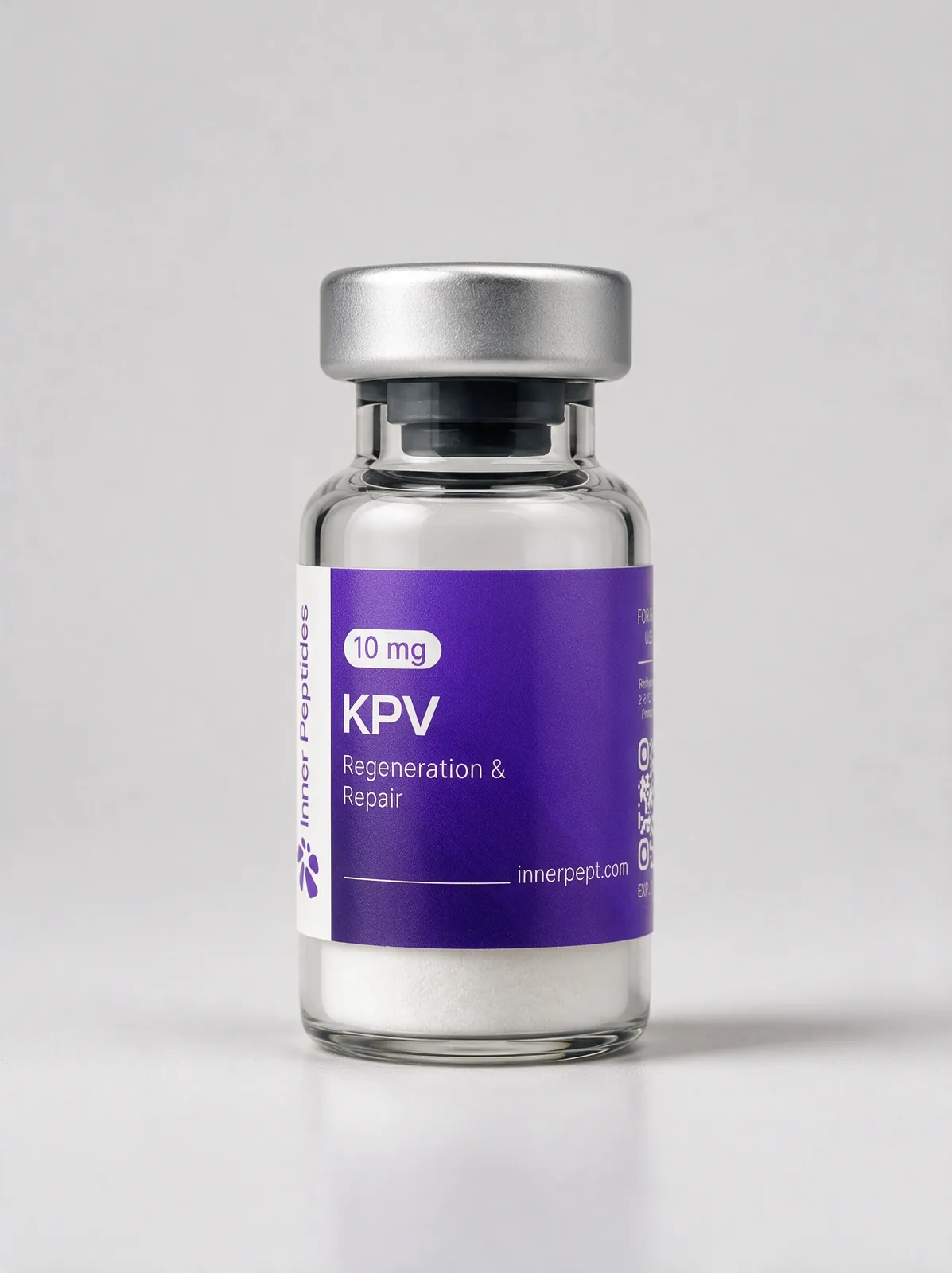
KPV
Estudiado por su relación con la inflamación.
Contenido del vial, no una dosis.
KPV es un pedacito de una sustancia que tu cuerpo ya produce y que usa para indicarle a la inflamación cuándo bajar. Se estudia porque conservaría buena parte de esa capacidad de calmarla, pero no su efecto sobre el color de la piel.
En qué te podría ayudar.
Puede interesarle a mujeres de 35 años en adelante cuya recuperación se ha vuelto más lenta, que sienten la piel o el intestino más reactivos que antes, o que notan que la inflamación se queda más tiempo del que solía. Dado que la evidencia aquí es preclínica, esto pertenece a una conversación con un profesional sobre el panorama completo; no es algo que se decida antes de ella.
Las cifras de arriba son la cantidad de péptido liofilizado que contiene el vial — no son una dosis. Tu protocolo, tiempos y duración se definen uno a uno con un profesional de la salud licenciado, a partir de tu historia y tus objetivos.
Los detalles técnicos, por si te interesan.
Todo lo que sigue es opcional: la ciencia detrás de este producto, para quien quiera leerla.
Qué es, en detalle
KPV es un péptido de tres aminoácidos — lisina, prolina y valina — que corresponde al extremo final de la alfa-MSH: los residuos 11 al 13 de una molécula de señalización que tu cuerpo ya produce. La investigación lo describe como un fragmento que conserva buena parte del carácter antiinflamatorio de la molécula original, dejando atrás su actividad relacionada con la pigmentación. Es pequeño, actúa desde el interior de la célula y no sobre un receptor de superficie, y es enzimáticamente lábil, algo que condiciona cómo se formula y se manipula. La investigación en péptidos lo ha examinado en modelos de tejido intestinal y cutáneo inflamado.
La alfa-MSH es una de las formas en que el cuerpo le indica a una respuesta inflamatoria cuándo replegarse. Esa instrucción es propia: no es algo que un compuesto introduzca. KPV se estudia como el fragmento que lleva ese mismo mensaje de calma, sumándose a una conversación que ya ocurre dentro de la célula en lugar de apagar el sistema entero desde afuera. Contención, no supresión.
Cómo funciona por dentro
KPV no actúa sobre un receptor en la superficie de la célula. La investigación sitúa su actividad dentro de la célula, en el paso donde una señal inflamatoria se transporta al núcleo para ser transcrita.
- Entrada al interior de la célula. A diferencia de su molécula de origen, KPV actúa de forma independiente de los receptores de melanocortina. En tejido intestinal, la investigación muestra que entra en las células a través del transportador de péptidos PepT1 (SLC15A1), en lugar de unirse en la superficie.
- Competencia con la importina-alfa. Dentro de la célula, KPV compite con la importina-alfa — la importina-alfa3 — por la señal de localización nuclear de la subunidad p65/RelA de NF-κB, y ocupa el sitio que de otro modo organizaría ese transporte.
- Translocación nuclear bloqueada. Con ese transporte bloqueado, p65 no llega al núcleo. En modelos preclínicos esto se corresponde con una menor transcripción de mensajeros inflamatorios como TNF-α, IL-1β e IL-6.
- Señalización MAPK. La investigación también reporta inhibición de la señalización MAPK a concentraciones nanomolares, una segunda vía implicada en cómo las células intensifican y sostienen una respuesta inflamatoria.
Lo que estudia la investigación
- Se estudia por su papel en la regulación que el propio cuerpo hace de la señalización inflamatoria, en el paso de la transcripción y no mediante una supresión amplia.
- Se ha examinado en modelos preclínicos de cicatrización de heridas, donde la inflamación sostenida es uno de los factores que pueden frenar la reparación de tejidos.
- Se explora en modelos animales e in vitro de colitis y dermatitis: intestino y piel, dos tejidos donde el tono inflamatorio se siente de cerca.
- La investigación lo describe como un fragmento que conserva buena parte de la actividad antiinflamatoria de la alfa-MSH, sin arrastrar los efectos sobre la pigmentación asociados a la molécula completa.
- Se plantea como un elemento dentro de un protocolo más amplio de regeneración y reparación, enmarcado por un profesional junto con la alimentación, el estrés y el contexto hormonal.
En qué punto está la investigación
La evidencia sobre KPV es preclínica. Se ha estudiado en cultivo celular y en modelos animales — colitis, dermatitis, cicatrización de heridas — y no se ha evaluado en ensayos clínicos en humanos. La molécula además es enzimáticamente lábil, una limitación conocida que los investigadores tienen que sortear. Lo publicamos con franqueza, en lugar de insinuar un historial en humanos que todavía no existe.
Ficha técnica
Conservación y manejo
Antes de empezar.
No publicamos vía, frecuencia ni dosis para KPV. La cifra de 10 mg que aparece en esta página describe el contenido del vial, no una cantidad para tomar. El protocolo completo — incluyendo si KPV es apropiado siquiera — se define de forma individual, con un profesional de la salud licenciado que conozca tu historia clínica.
Cualquier fecha que publicáramos sería invención, no evidencia. KPV no se ha estudiado en humanos, así que no hay un cronograma clínico que citar, y los patrones inflamatorios difieren enormemente según lo que los esté impulsando. Qué señales observar — y cuánto tiempo darles — se define en consulta.
Sí, y la revisión va primero, antes de que se escriba ningún protocolo. Un profesional de la salud licenciado debería leer tu historia clínica, mirar qué más estás tomando y evaluar si un péptido de señalización antiinflamatoria encaja en el panorama. Esa evaluación es el punto de partida.
Porque el tripéptido simple es enzimáticamente lábil: se degrada con facilidad. Una versión acetilada y amidada, Ac-KPV-NH2, es una forma distinta y más estable, con su propio número CAS. Cuál de las dos es relevante para un protocolo determinado es una cuestión de formulación que le corresponde a tu profesional de la salud, no algo que resolvamos aquí.
Comparte un origen. KPV son los tres últimos residuos de la alfa-MSH, el péptido de melanocortina implicado en la pigmentación. Pero la investigación indica que KPV actúa de forma independiente de los receptores de melanocortina, trabajando dentro de la célula, y la actividad sobre la pigmentación de la molécula completa no se traslada.
Cada fórmula de Inner Peptides se analiza de forma independiente antes de enviarse, con un Certificado de Análisis disponible si lo pides. Conoce más sobre nuestro estándar de análisis.