
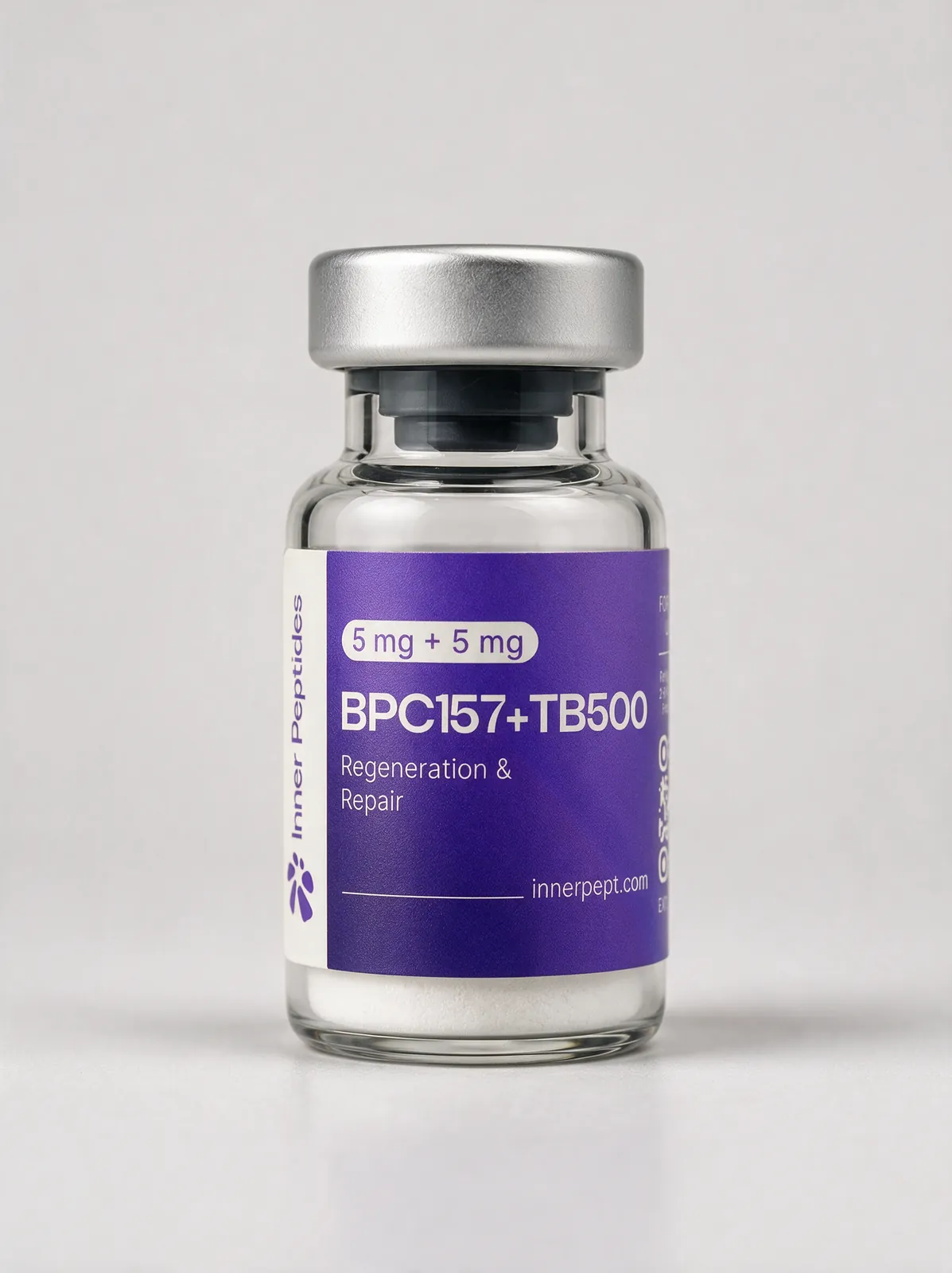
BPC-157 + TB-500
Dos péptidos en estudio para la reparación de tu cuerpo.
Contenido del vial, no una dosis.
Esta fórmula junta dos péptidos: BPC-157 y TB-500. Cada uno copia un pedacito de una proteína que tu cuerpo ya tiene. Una de esas proteínas está en los jugos del estómago y la otra, en la mayoría de tus células. Los dos se estudian por su papel en cómo el cuerpo repara lo que se lastima.
En qué te podría ayudar.
Para mujeres de 35 años en adelante que llevan una vida activa, se están recuperando de una lesión de tejido blando o notan que reponerse de un esfuerzo cotidiano les toma más tiempo que antes. Es para quienes quieren entender un mecanismo y los límites de su evidencia antes de empezar, y a quienes no les incomoda saber que esta combinación se ubica de lleno en la investigación preclínica.
Las cifras de arriba son la cantidad de péptido liofilizado que contiene el vial — no son una dosis. Tu protocolo, tiempos y duración se definen uno a uno con un profesional de la salud licenciado, a partir de tu historia y tus objetivos.
Qué hay realmente en el vial.
Es una fórmula combinada: cada cifra es la parte de ese componente dentro del vial.
Los detalles técnicos, por si te interesan.
Todo lo que sigue es opcional: la ciencia detrás de este producto, para quien quiera leerla.
Qué es, en detalle
BPC-157 es un pentadecapéptido sintético de 15 aminoácidos, cuya secuencia proviene de un segmento parcial de una proteína presente en el jugo gástrico humano — el "Body Protection Compound" del que toma su nombre. TB-500 es un fragmento sintético más corto, Ac-LKKTETQ, que corresponde a la región de unión a la actina de la timosina beta-4, una proteína de 43 aminoácidos presente en la mayoría de las células humanas. Ambos se estudian por su papel en la señalización de la reparación de tejidos.
La reparación no es una capacidad que haya que darle al cuerpo. Es una secuencia que él ya ejecuta — vasos que se reclutan, células que se desplazan a su lugar, tejido que se reconstruye — y que responde con menos prontitud a medida que cambian los patrones hormonales y metabólicos. Los dos péptidos de este vial se estudian a lo largo de esa misma secuencia que ya existe, como un recordatorio de ella y no como un sustituto.
Cómo funciona por dentro
Los dos se estudian por rutas distintas, aunque contiguas. BPC-157 aparece en la literatura sobre todo a nivel de los vasos sanguíneos y la señalización local; TB-500, a nivel del andamiaje interno de la célula.
- Señalización del óxido nítrico. Los trabajos en animales describen a BPC-157 actuando a través del sistema del óxido nítrico — una vía que el cuerpo ya usa para regular el tono vascular y el flujo sanguíneo local alrededor del tejido dañado.
- Vías angiogénicas y de adhesión. Los estudios preclínicos vinculan a BPC-157 con la cascada VEGFR2–Akt–eNOS, asociada a la formación de nuevos vasos, y con la señalización FAK–paxilina, asociada a la manera en que las células se adhieren y migran.
- Unión a la actina. TB-500 corresponde a los residuos 17–23 de la timosina beta-4, la región de unión a la actina de una proteína secuestradora de actina presente en la mayoría de las células humanas. La regulación de la actina gobierna cómo las células cambian de forma y se desplazan.
- Akt/mTOR y factores de crecimiento. En modelos animales, TB-500 se estudia junto con la señalización Akt/mTOR y el aumento de VEGF y angiopoyetina-1, con efectos reportados sobre el cierre de heridas y el grado de fibrosis.
Lo que estudia la investigación
- Reúne dos péptidos estudiados en modelos animales por su papel en partes contiguas de la secuencia de reparación — la señalización vascular y el movimiento del citoesqueleto — en lugar de un solo estímulo aislado.
- BPC-157 se investiga en trabajos preclínicos por la reparación de tendones y ligamentos, la integridad del tejido intestinal y la señalización antiinflamatoria.
- TB-500 se estudia en modelos animales por la cicatrización de heridas, la reparación de tejido tendinoso y cardíaco, y la regulación de la fibrosis.
- Podría apoyar la señalización que el cuerpo ya usa para repararse, en lugar de introducir una instrucción que no lleva consigo.
- Se contempla como un elemento dentro de un protocolo dirigido por un profesional de la salud, iniciado con el carácter preclínico de la investigación comprendido de antemano.
En qué punto está la investigación
La evidencia aquí es preclínica. BPC-157 se apoya en más de cien estudios en animales, la mayoría procedentes de un solo laboratorio croata, y prácticamente sin ensayos clínicos controlados en humanos completados — una revisión sistemática de 2025 de la literatura ortopédica encontró apenas un estudio clínico entre ellos, y ningún dato clínico de seguridad. La investigación en humanos de TB-500 corresponde a su proteína original completa, no a este fragmento.
Ficha técnica
Conservación y manejo
Antes de empezar.
No publicamos una vía de administración, ni un esquema, ni una cantidad para esta combinación. Los 5 mg y 5 mg de la etiqueta describen lo que hay en el vial, no lo que alguien toma. La administración, la frecuencia y la duración se definen de forma individual con un profesional de la salud licenciado durante la consulta, a partir de tu historial y del tejido involucrado.
En esta página no aparece ningún plazo, porque la investigación no sostiene ninguno. La reparación depende del tipo de tejido, de la naturaleza del esfuerzo y de tu propia fisiología — y, más allá de eso, sencillamente no existe una base de evidencia en humanos para esta combinación de la cual deducirlo. Tu profesional de la salud puede establecer expectativas para tu caso y decirte qué vale la pena observar.
Sí. Esta no es una combinación para empezar por tu cuenta. Un profesional de la salud licenciado debería revisar tu historial de salud, sopesar el carácter preclínico de la investigación frente a lo que buscas lograr y confirmar si es apropiada para ti antes de que algo empiece — y seguir acompañándote una vez que comience.
No, y la distinción importa. TB-500 es un fragmento sintético de siete residuos, Ac-LKKTETQ, que corresponde a los residuos 17–23 de la timosina beta-4 — la región de unión a la actina de una proteína de 43 aminoácidos. A menudo se mencionan como si fueran lo mismo, pero no son intercambiables. La mayor parte de la investigación en humanos que existe corresponde a la proteína completa; este vial contiene el fragmento.
Se estudian en partes contiguas de la misma secuencia de reparación. El trabajo preclínico con BPC-157 se centra en la señalización del óxido nítrico y la señalización vascular, y en el tejido intestinal; el de TB-500, en la regulación de la actina y la migración celular. Combinarlos abarca una porción mayor de esa secuencia — aunque la combinación en sí no se ha examinado en ensayos clínicos controlados.
Cada fórmula de Inner Peptides se analiza de forma independiente antes de enviarse, con un Certificado de Análisis disponible si lo pides. Conoce más sobre nuestro estándar de análisis.