
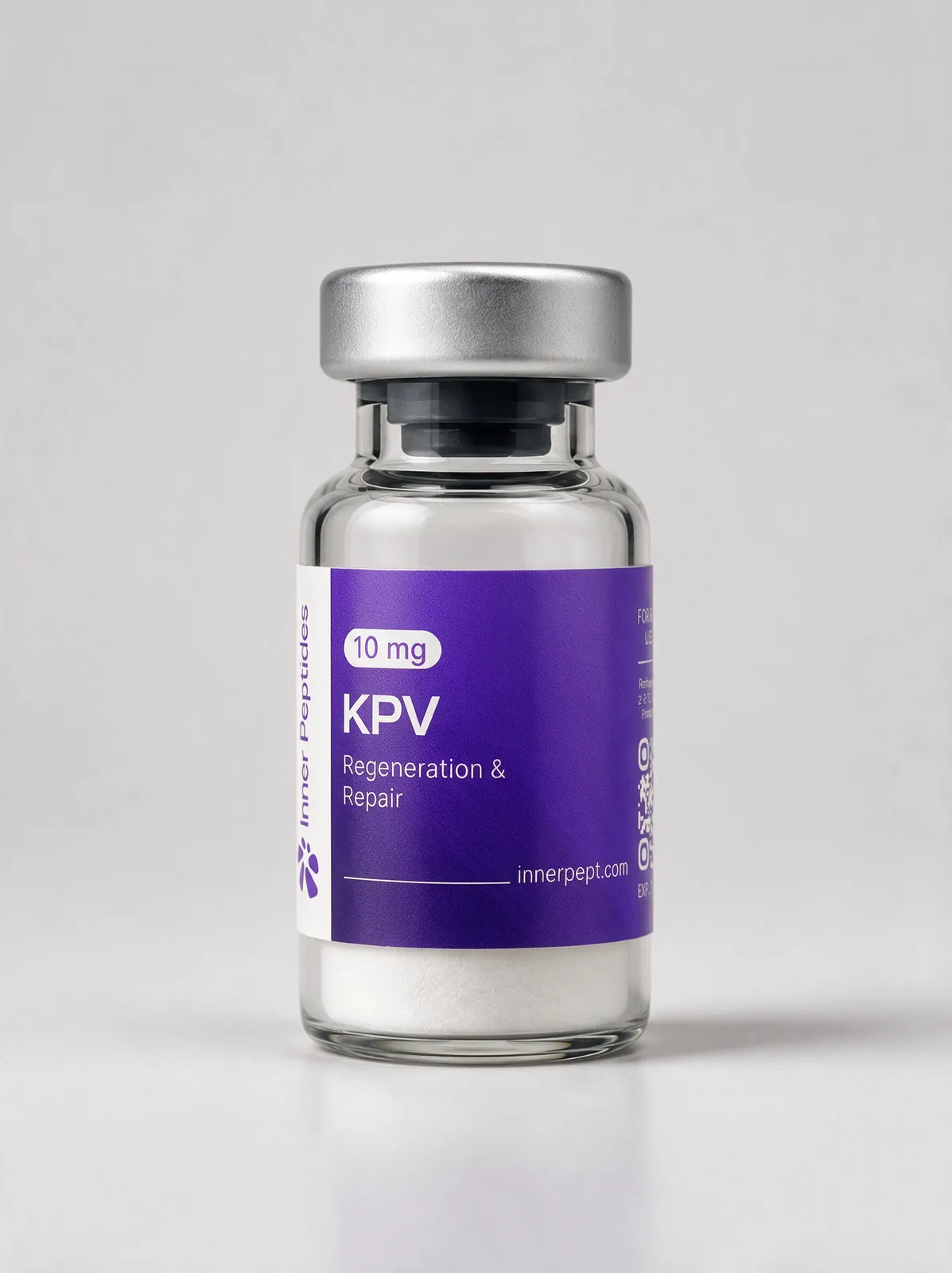
KPV
Studied for its link to inflammation.
Vial content, not a dose.
KPV is a tiny piece of a substance your body already makes and uses to tell inflammation when to calm down. It's being studied because it may keep much of that calming ability, but not the effect the full substance has on skin color.
How it might help you.
This may be of interest to women 35 and older whose recovery has slowed, whose skin or gut feels more reactive than it once did, or who notice inflammation lingering past the point it used to settle. Given that the evidence here is preclinical, it belongs in a conversation with a practitioner about the wider picture — not ahead of one.
The figures above are the amount of lyophilized peptide in the vial — they are not a dose. Your protocol, timing, and duration are set one-to-one with a licensed practitioner based on your history and goals.
The technical details, if you're curious.
Everything below is optional: the science behind this product, for anyone who wants to read it.
What it is, in detail
KPV is a three-amino-acid peptide — lysine, proline, valine — corresponding to the tail end of alpha-MSH, residues 11 through 13 of a signaling molecule the body already produces. Research describes it as retaining much of the parent molecule's anti-inflammatory character while leaving its pigmentation-related activity behind. It is small, it acts from inside the cell rather than at a surface receptor, and it is enzymatically labile, which shapes how it is formulated and handled. Peptide research has examined it in models of inflamed gut and skin tissue.
Alpha-MSH is one of the ways the body tells an inflammatory response when to stand down. That instruction is native — it is not something a compound introduces. KPV is studied as the fragment that carries that same quieting message, working with a conversation already underway inside the cell rather than shutting the whole system off from the outside. Restraint, not suppression.
How it works inside the body
KPV does not work at a receptor on the cell surface. Research places its activity inside the cell, on the step where an inflammatory signal is carried into the nucleus to be transcribed.
- Intracellular uptake. Unlike its parent molecule, KPV acts independently of melanocortin receptors. In gut tissue, research shows it entering cells through the PepT1 (SLC15A1) peptide transporter rather than binding at the surface.
- Importin-alpha competition. Inside the cell, KPV competes with importin-alpha — importin-alpha3 — for the nuclear-localization signal on the NF-κB subunit p65/RelA, occupying the site that would otherwise arrange transport.
- Blocked nuclear translocation. With that transport blocked, p65 does not reach the nucleus. In preclinical models this corresponds to reduced transcription of inflammatory messengers including TNF-α, IL-1β, and IL-6.
- MAPK signaling. Research also reports inhibition of MAPK signaling at nanomolar concentrations, a second pathway involved in how cells escalate and sustain an inflammatory response.
What the research looks at
- Is studied for its role in the body's own regulation of inflammatory signaling, at the transcription step rather than through broad suppression.
- Has been examined in preclinical models of wound healing, where sustained inflammation is one of the factors that can slow tissue repair.
- Is explored in animal and in-vitro models of colitis and dermatitis — gut and skin, two tissues where inflammatory tone is closely felt.
- Research describes it as retaining much of alpha-MSH's anti-inflammatory activity while leaving behind the pigmentation effects associated with the full-length molecule.
- Is positioned as one element of a longer regeneration and repair protocol, framed by a practitioner alongside diet, stress, and hormonal context.
Where the research stands
The evidence for KPV is preclinical. It has been studied in cell culture and in animal models — colitis, dermatitis, wound healing — and has not been evaluated in human clinical trials. The molecule is also enzymatically labile, which is a known limitation researchers work around. We publish that plainly rather than implying a human record that does not yet exist.
Technical specifications
Storage & handling
Before you start.
We do not publish a route, a frequency, or a dose for KPV. The 10 mg figure on this page describes the content of the vial, not an amount to take. The full protocol — including whether KPV is appropriate at all — is decided individually, with a licensed practitioner who has seen your history.
Any date we printed would be invention rather than evidence. KPV has not been studied in humans, so there is no clinical timeline to quote, and inflammatory patterns differ enormously depending on what is driving them. Which signals to watch — and how long to give them — is settled in consultation.
Yes — and the review comes first, before any protocol is written. A licensed practitioner should read your history, look at what else you are taking, and judge whether an anti-inflammatory signaling peptide fits the picture at all. That evaluation is the starting point,
Because the plain tripeptide is enzymatically labile — it breaks down readily. An acetylated and amidated version, Ac-KPV-NH2, is a distinct and more stable form with its own CAS number. Which form is relevant to a given protocol is a formulation question for your practitioner, not something we settle here.
It shares an origin. KPV is the final three residues of alpha-MSH, the melanocortin peptide involved in pigmentation. But research indicates KPV acts independently of melanocortin receptors, working inside the cell instead, and the pigmentation activity of the full-length molecule is not carried over.
Every Inner Peptides formula is independently tested before it ships, with a Certificate of Analysis available whenever you ask for it. Learn more about our testing standard.