
Kisspeptin-10
A brain messenger, studied in fertility and desire research.
Vial content, not a dose.
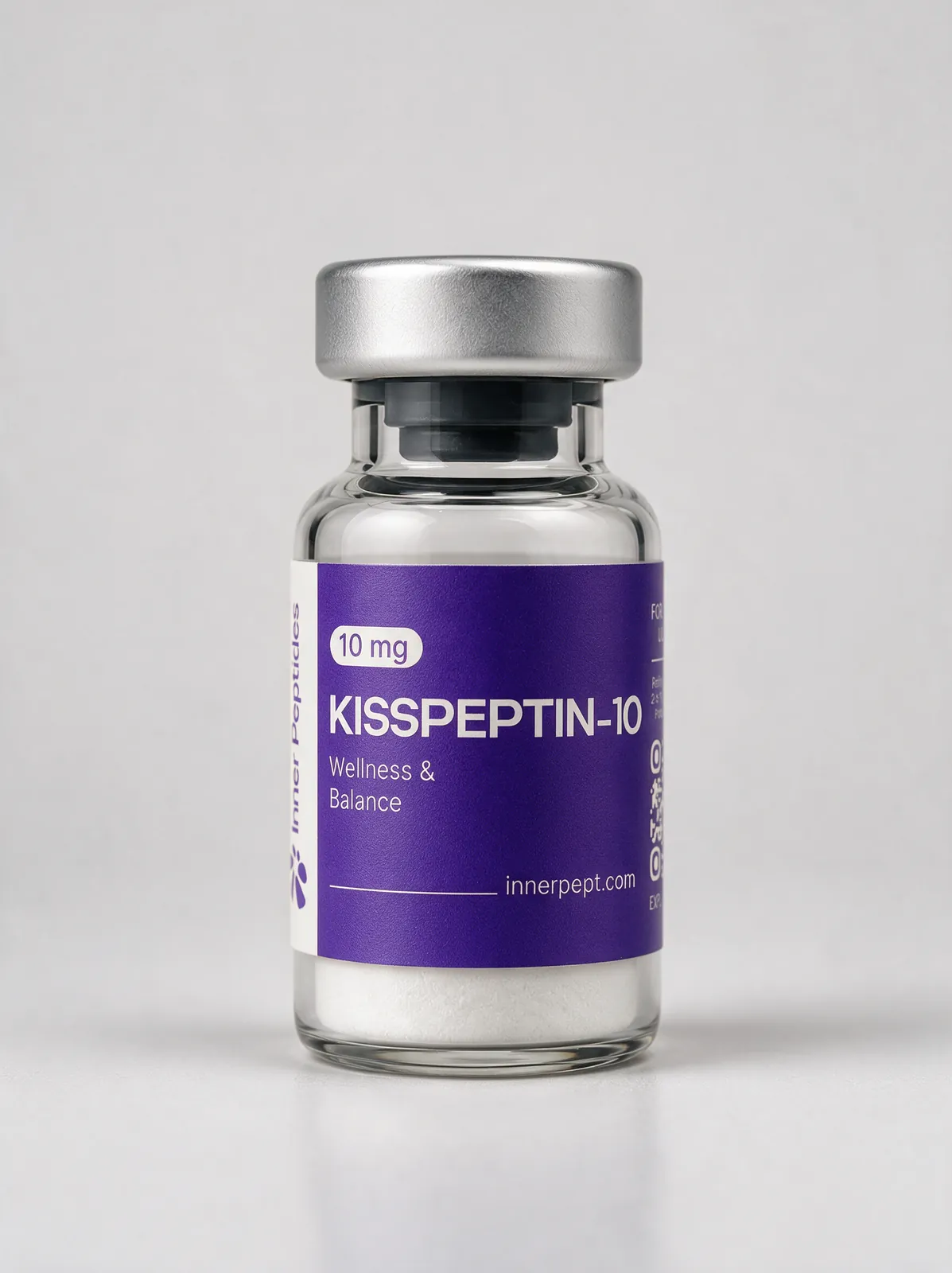
Kisspeptin-10 is a small piece of a messenger your body already makes. It isn't a sex hormone: that messenger works in your brain and sends the first signal to the hormones behind your cycle. It's studied for what it sets in motion, not because it adds hormones to your body.
How it might help you.
Kisspeptin-10 is of interest to women 35 and older whose questions sit at the level of the hypothalamic-pituitary axis itself — cycle signaling, reproductive endocrinology, or desire that seems to originate upstream of hormone levels. It is not a general wellness peptide; it belongs in a conversation with a practitioner who reads the whole axis.
The figures above are the amount of lyophilized peptide in the vial — they are not a dose. Your protocol, timing, and duration are set one-to-one with a licensed practitioner based on your history and goals.
The technical details, if you're curious.
Everything below is optional: the science behind this product, for anyone who wants to read it.
What it is, in detail
Kisspeptin-10 is a ten-amino-acid neuropeptide — a fragment of the larger metastin molecule — that sits at the very top of the reproductive hormone cascade, upstream of GnRH. It is not a sex hormone and does not act as one. Its role is to signal: it speaks to the hypothalamic neurons that initiate the reproductive sequence, and everything downstream — GnRH, then LH and FSH — follows from that initial instruction. In research it is studied for what it starts, not what it supplies.
Kisspeptin is a signal your body already writes; the reproductive axis has always been opened by it. What matters here is the pattern, not the volume — Kisspeptin-10 is studied for prompting GnRH in the pulsatile rhythm the hypothalamus already uses, rather than imposing a steady hormonal input from outside. Reminding the axis how it starts, instead of overriding what comes after.
How it works inside the body
Kisspeptin-10 works at the top of the reproductive cascade, upstream of GnRH. Rather than supplying a hormone, it engages the receptor that tells the hypothalamus to begin its own sequence.
- KISS1R binding. Kisspeptin-10 binds KISS1R, also known as GPR54, on hypothalamic GnRH neurons — the same receptor the body's own kisspeptin uses to open the reproductive cascade.
- Gq/11 signaling. Receptor activation couples through Gq/11 proteins, mobilizing intracellular calcium and engaging the ERK1/2 and p38 MAPK cascades inside the neuron itself.
- Pulsatile GnRH release. Those cascades prompt the neuron to release GnRH in the pulsatile pattern the hypothalamus already uses — timing being as much of the message as quantity.
- Downstream LH and FSH. The pituitary reads that pulse and releases LH and FSH. Kisspeptin-10 does not produce sex steroids itself; it acts upstream, at the point where the sequence begins.
What the research looks at
- Engages KISS1R (GPR54), the receptor the body's own kisspeptin uses to open the reproductive hormone cascade at its highest point.
- Is studied for its role in prompting GnRH release in the pulsatile pattern the hypothalamus already uses, rather than a continuous one.
- Has been researched in reproductive endocrinology, including work on oocyte maturation, hypothalamic amenorrhea, and idiopathic hypogonadotropic hypogonadism.
- Is also explored in sexual-desire research, where interest centers on signaling upstream of the hormones themselves rather than on the hormones directly.
- Does not supply sex steroids itself; it acts on the signaling layer above them, which is why it belongs in a practitioner-directed plan.
Where the research stands
Kisspeptin-10 has been evaluated in human studies — Phase 1 and Phase 2 work in reproductive endocrinology, including controlled trials in fertility settings. No Phase 3 program has been completed, so the evidence base is real but early. It is clinical research, not settled practice, and the gap between those two is the whole of what a consultation is for.
Technical specifications
Storage & handling
Before you start.
We don't publish a route, dose, or schedule for Kisspeptin-10. The 10 mg on the vial is the amount of peptide in the vial, not a dose. Administration is confirmed by a licensed practitioner before anything begins, based on your history, your labs, and what else is already part of your care.
We don't attach a timeline to it. Kisspeptin-10 acts on a signaling axis, and what happens downstream depends on your own baseline — hormonal, metabolic, and otherwise. Your practitioner can name the markers that matter in your case and decide when to look at them again.
Yes. Kisspeptin-10 acts on the hypothalamic-pituitary axis, which coordinates a great deal more than one system. It should only be considered with a licensed practitioner who can review your health history, your current medications, and how it would sit alongside anything else you're already doing.
Because the signal is meant to be brief. Kisspeptin-10 clears in roughly four minutes, and the receptor it acts on — KISS1R — desensitizes under continuous exposure rather than responding more strongly. The body's own signaling here is pulsatile, so the pattern of administration matters as much as anything else, and that pattern is set by your practitioner.
No. Kisspeptin-10 does not supply estrogen, progesterone, or any other sex steroid, and it does not act like one. It engages a receptor one level above GnRH and leaves the rest of the sequence to the body — which is a different proposition from replacing a hormone, and a different conversation to have with your practitioner.
Every Inner Peptides formula is independently tested before it ships, with a Certificate of Analysis available whenever you ask for it. Learn more about our testing standard.