
PT-141
Focused on desire, starting in the brain.
Vial content, not a dose.
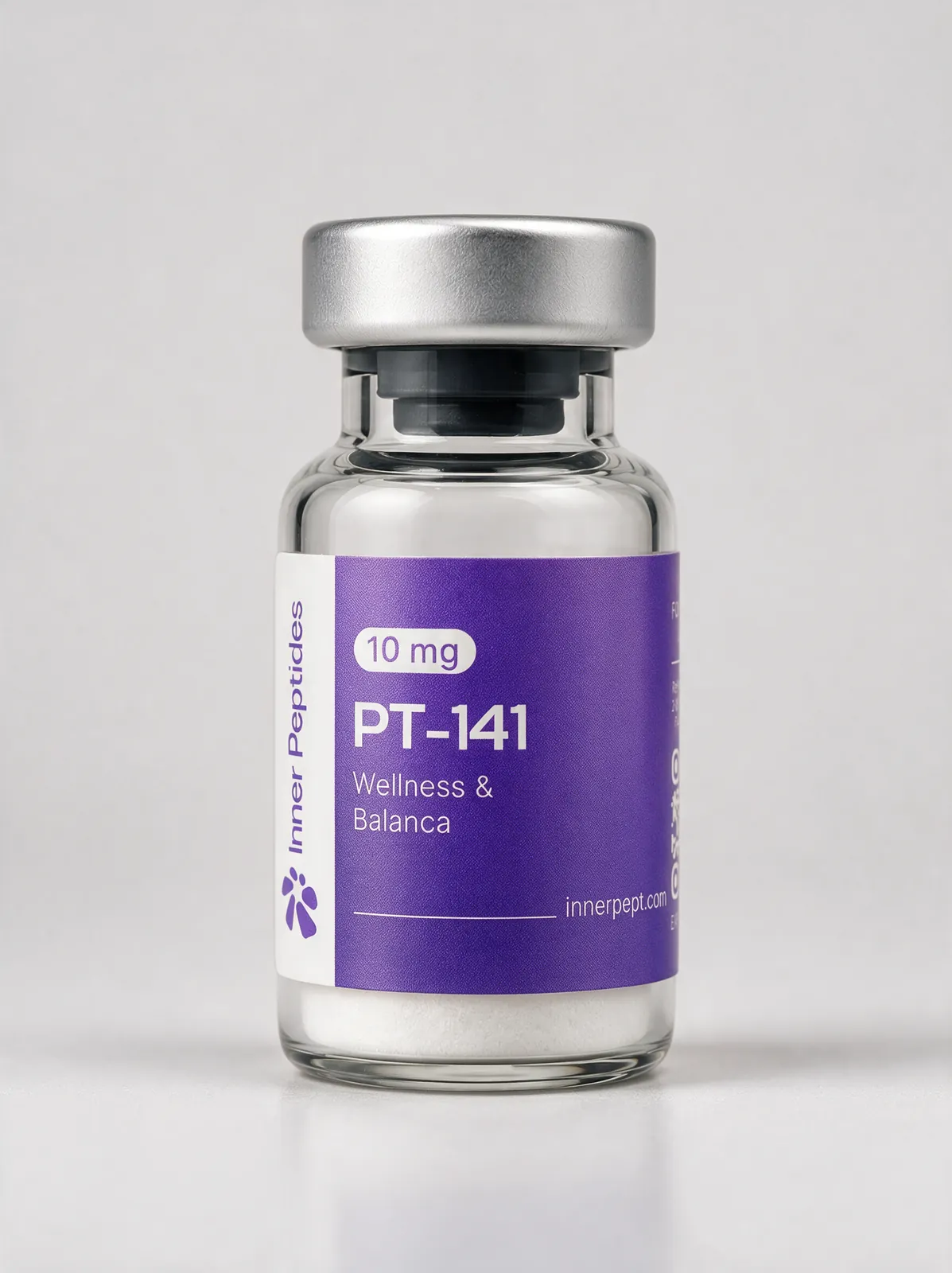
PT-141 is a peptide: a short protein chain, similar to a substance your own body makes. It's being studied for how it acts on the parts of the brain linked to sexual desire, not on blood flow. In other words, the focus is on the wanting more than on the physical response.
How it might help you.
This is most relevant for women 35 and older who notice desire has receded during hormonal transition, prolonged stress, or the metabolic shifts of midlife — particularly when the change sits in wanting rather than in physical response. It is considered against a full hormonal picture, established with a practitioner, not addressed as an isolated symptom.
The figures above are the amount of lyophilized peptide in the vial — they are not a dose. Your protocol, timing, and duration are set one-to-one with a licensed practitioner based on your history and goals.
The technical details, if you're curious.
Everything below is optional: the science behind this product, for anyone who wants to read it.
What it is, in detail
PT-141, also known as bremelanotide, is a synthetic cyclic peptide of seven amino acids, structurally derived from alpha-MSH — a signaling molecule the body produces on its own. Rather than acting on blood vessels or local tissue, it belongs to a family of compounds that speak to the brain: it engages melanocortin receptors in regions of the hypothalamus and limbic system associated with sexual desire. It has been studied most extensively in premenopausal women reporting a persistent, distressing loss of desire.
Desire is not something the body has to be taught. It is generated by a signaling pathway that already exists — one that can quiet under hormonal transition, chronic stress, or sustained fatigue. PT-141 is studied for its work within that same pathway: engaging receptors the brain already uses to read and relay arousal, rather than substituting a different mechanism for the one that went quiet.
How it works inside the body
PT-141 acts centrally rather than peripherally. Its path runs through the melanocortin system — the same receptor family the body's own alpha-MSH uses to relay signals within the hypothalamus and surrounding limbic structures.
- Structural mimicry. As a cyclic analogue of alpha-MSH, PT-141 is recognized by the same receptor family that endogenous melanocortin signaling uses, which is why it engages an existing pathway rather than a new one.
- MC4R activation. Its principal target is the melanocortin-4 receptor (MC4R), with additional activity at MC3R. These receptors sit on neurons in the hypothalamus, a region that coordinates hormonal and behavioral signaling.
- Central desire pathways. Activation there modulates the hypothalamic and limbic circuits associated with sexual desire — signaling that shapes wanting itself, upstream of and distinct from the physical response.
- Not a vascular route. Because the pathway is neural, PT-141 does not work by altering peripheral blood flow. That distinction is what separates it from compounds addressing the mechanical side of sexual response.
What the research looks at
- Is studied for its role in the central melanocortin signaling the body already uses to relay sexual desire.
- May support desire that has quieted at the level of neural signaling rather than at the level of physical response.
- Has been evaluated in controlled clinical research in premenopausal women reporting persistent low desire accompanied by personal distress.
- Acts through a central pathway, which is why it is explored as part of a hormonal picture rather than a local or topical measure.
- Is considered within an individualized protocol, introduced and monitored by a licensed practitioner alongside the rest of your hormonal and metabolic context.
Where the research stands
The human evidence here is unusually developed for a peptide. PT-141 was evaluated through a Phase 3 clinical program in premenopausal women, with desire and the distress associated with its loss as the endpoints under study. That program studied one population specifically, and that is the population the human data speaks to — which is exactly the kind of detail a consultation exists to work through.
Technical specifications
Storage & handling
Before you start.
Administration is individualized and settled in consultation, not on a product page. What we can say is that the 10 mg figure on this page describes the content of the vial, not a dose — those are different things. Route, amount, and frequency are confirmed by a licensed practitioner who has reviewed your history and goals.
We do not attach a timeline to this. Response varies with baseline hormonal status, stress load, and the rest of the protocol built around it. What a meaningful change would look like, and how long to give it, is decided with your practitioner rather than assumed here.
Yes. PT-141 acts on central melanocortin signaling, which touches the hypothalamus and its wider hormonal coordination, so it belongs in a supervised protocol rather than a self-directed one. A licensed practitioner reviews your health history, current medications, and goals before deciding whether it fits — and stays involved once it does.
No. Blood-flow approaches address the mechanical side of sexual response, working peripherally on circulation. PT-141 works centrally, through melanocortin receptors in the brain, on the signaling associated with desire itself. The two address different parts of the picture, which is why the question of which is relevant belongs in consultation.
No. It is a synthetic cyclic peptide of seven amino acids, modelled on alpha-MSH, a signaling molecule the body already produces. It does not supply a hormone or replace one. It engages a receptor family the brain already uses, which is the difference between reminding a system of a signal and overriding it.
Every Inner Peptides formula is independently tested before it ships, with a Certificate of Analysis available whenever you ask for it. Learn more about our testing standard.