
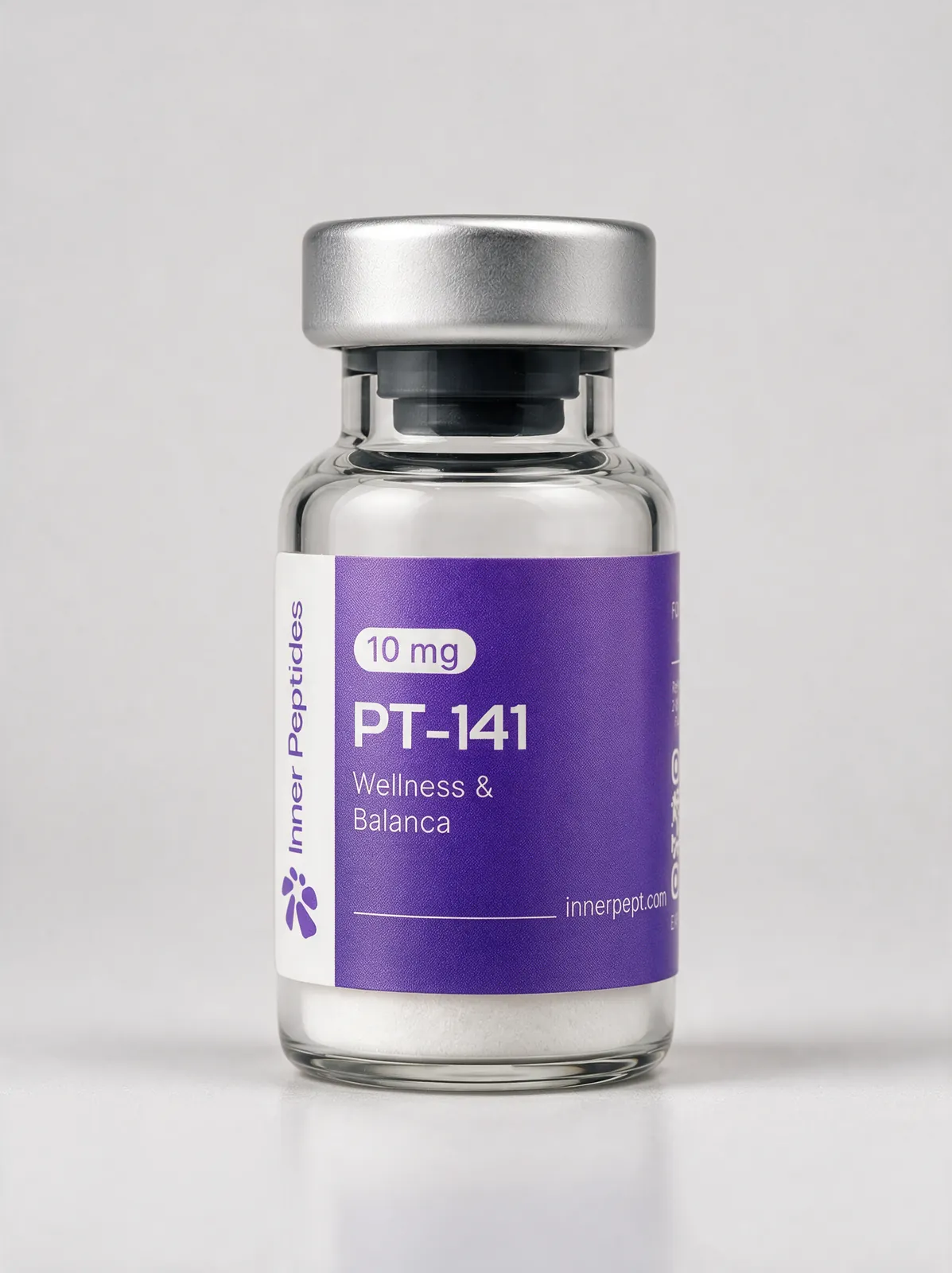
PT-141
Enfocado en el deseo, desde el cerebro.
Contenido del vial, no una dosis.
PT-141 es un péptido: una cadena corta de proteína, parecida a una sustancia que tu propio cuerpo produce. Se estudia por cómo actúa en las partes del cerebro relacionadas con el deseo sexual, y no en la circulación de la sangre. Es decir, en las ganas más que en la respuesta física.
En qué te podría ayudar.
Es más relevante para mujeres de 35 años en adelante que notan que el deseo se ha apagado durante una transición hormonal, un estrés prolongado o los cambios metabólicos de la mediana edad, sobre todo cuando el cambio está en el querer y no en la respuesta física. Se evalúa frente a un panorama hormonal completo, establecido junto a un profesional, y no se aborda como un síntoma aislado.
Las cifras de arriba son la cantidad de péptido liofilizado que contiene el vial — no son una dosis. Tu protocolo, tiempos y duración se definen uno a uno con un profesional de la salud licenciado, a partir de tu historia y tus objetivos.
Los detalles técnicos, por si te interesan.
Todo lo que sigue es opcional: la ciencia detrás de este producto, para quien quiera leerla.
Qué es, en detalle
PT-141, también conocido como bremelanotide, es un péptido cíclico sintético de siete aminoácidos, derivado estructuralmente de la alfa-MSH, una molécula de señalización que el cuerpo produce por su cuenta. En lugar de actuar sobre los vasos sanguíneos o el tejido local, pertenece a una familia de compuestos que le hablan al cerebro: actúa sobre receptores de melanocortina en regiones del hipotálamo y del sistema límbico asociadas con el deseo sexual. Se ha estudiado sobre todo en mujeres premenopáusicas que reportan una pérdida del deseo persistente que les genera malestar.
El deseo no es algo que haya que enseñarle al cuerpo. Lo genera una vía de señalización que ya existe, una que puede atenuarse durante una transición hormonal, un estrés crónico o una fatiga sostenida. PT-141 se estudia por su acción dentro de esa misma vía: actúa sobre receptores que el cerebro ya usa para leer y transmitir la excitación, en lugar de sustituir por otro el mecanismo que se apagó.
Cómo funciona por dentro
PT-141 actúa a nivel central, no periférico. Su recorrido pasa por el sistema de melanocortinas: la misma familia de receptores que la propia alfa-MSH del cuerpo utiliza para transmitir señales dentro del hipotálamo y las estructuras límbicas que lo rodean.
- Mimetismo estructural. Como análogo cíclico de la alfa-MSH, PT-141 es reconocido por la misma familia de receptores que utiliza la señalización endógena de melanocortinas, y por eso actúa sobre una vía que ya existe y no sobre una nueva.
- Activación del MC4R. Su diana principal es el receptor de melanocortina 4 (MC4R), con actividad adicional en MC3R. Estos receptores se ubican en neuronas del hipotálamo, una región que coordina la señalización hormonal y conductual.
- Vías centrales del deseo. Esa activación modula los circuitos hipotalámicos y límbicos asociados con el deseo sexual: la señalización que da forma al querer mismo, previa y distinta de la respuesta física.
- No es una vía vascular. Como la vía es neural, PT-141 no funciona modificando el flujo sanguíneo periférico. Esa distinción es lo que lo separa de los compuestos que abordan el lado mecánico de la respuesta sexual.
Lo que estudia la investigación
- Se estudia por su papel en la señalización central de melanocortinas que el cuerpo ya usa para transmitir el deseo sexual.
- Podría apoyar el deseo que se atenuó en el plano de la señalización neural y no en el de la respuesta física.
- Se ha evaluado en investigación clínica controlada en mujeres premenopáusicas que reportan un deseo bajo persistente acompañado de malestar personal.
- Actúa a través de una vía central, y por eso se explora como parte de un panorama hormonal y no como una medida local o tópica.
- Se considera dentro de un protocolo individualizado, introducido y monitoreado por un profesional de la salud licenciado junto con el resto de tu contexto hormonal y metabólico.
En qué punto está la investigación
La evidencia en humanos es, en este caso, inusualmente amplia para un péptido. PT-141 se evaluó en un programa clínico de Fase 3 en mujeres premenopáusicas, con el deseo y el malestar asociado a su pérdida como criterios de valoración bajo estudio. Ese programa estudió una población específica, y es de esa población de la que hablan los datos en humanos: justamente el tipo de detalle que una consulta existe para revisar contigo.
Ficha técnica
Conservación y manejo
Antes de empezar.
La administración es individualizada y se define en consulta, no en la página de un producto. Lo que sí podemos decir es que la cifra de 10 mg de esta página describe el contenido del vial, no una dosis: son cosas distintas. La vía, la cantidad y la frecuencia las confirma un profesional de la salud licenciado que haya revisado tu historia y tus objetivos.
No le ponemos un tiempo a esto. La respuesta varía según el estado hormonal de base, la carga de estrés y el resto del protocolo que se construye alrededor. Qué sería un cambio significativo, y cuánto tiempo darle, se decide con tu profesional de la salud y no se asume aquí.
Sí. PT-141 actúa sobre la señalización central de melanocortinas, que toca el hipotálamo y su coordinación hormonal más amplia, así que pertenece a un protocolo supervisado y no a uno autodirigido. Un profesional de la salud licenciado revisa tu historia de salud, tus medicamentos actuales y tus objetivos antes de decidir si tiene sentido para ti, y sigue acompañándote una vez que lo hace.
No. Los enfoques que trabajan sobre el flujo sanguíneo abordan el lado mecánico de la respuesta sexual, actuando de forma periférica sobre la circulación. PT-141 actúa a nivel central, a través de receptores de melanocortina en el cerebro, sobre la señalización asociada con el deseo mismo. Cada uno atiende una parte distinta del panorama, y por eso la pregunta de cuál es relevante para ti corresponde a la consulta.
No. Es un péptido cíclico sintético de siete aminoácidos, modelado a partir de la alfa-MSH, una molécula de señalización que el cuerpo ya produce. No aporta una hormona ni reemplaza ninguna. Actúa sobre una familia de receptores que el cerebro ya usa, y esa es la diferencia entre recordarle una señal a un sistema y pasar por encima de él.
Cada fórmula de Inner Peptides se analiza de forma independiente antes de enviarse, con un Certificado de Análisis disponible si lo pides. Conoce más sobre nuestro estándar de análisis.