
Epithalon
Studied for its link to the body's internal clock.
Vial content, not a dose.
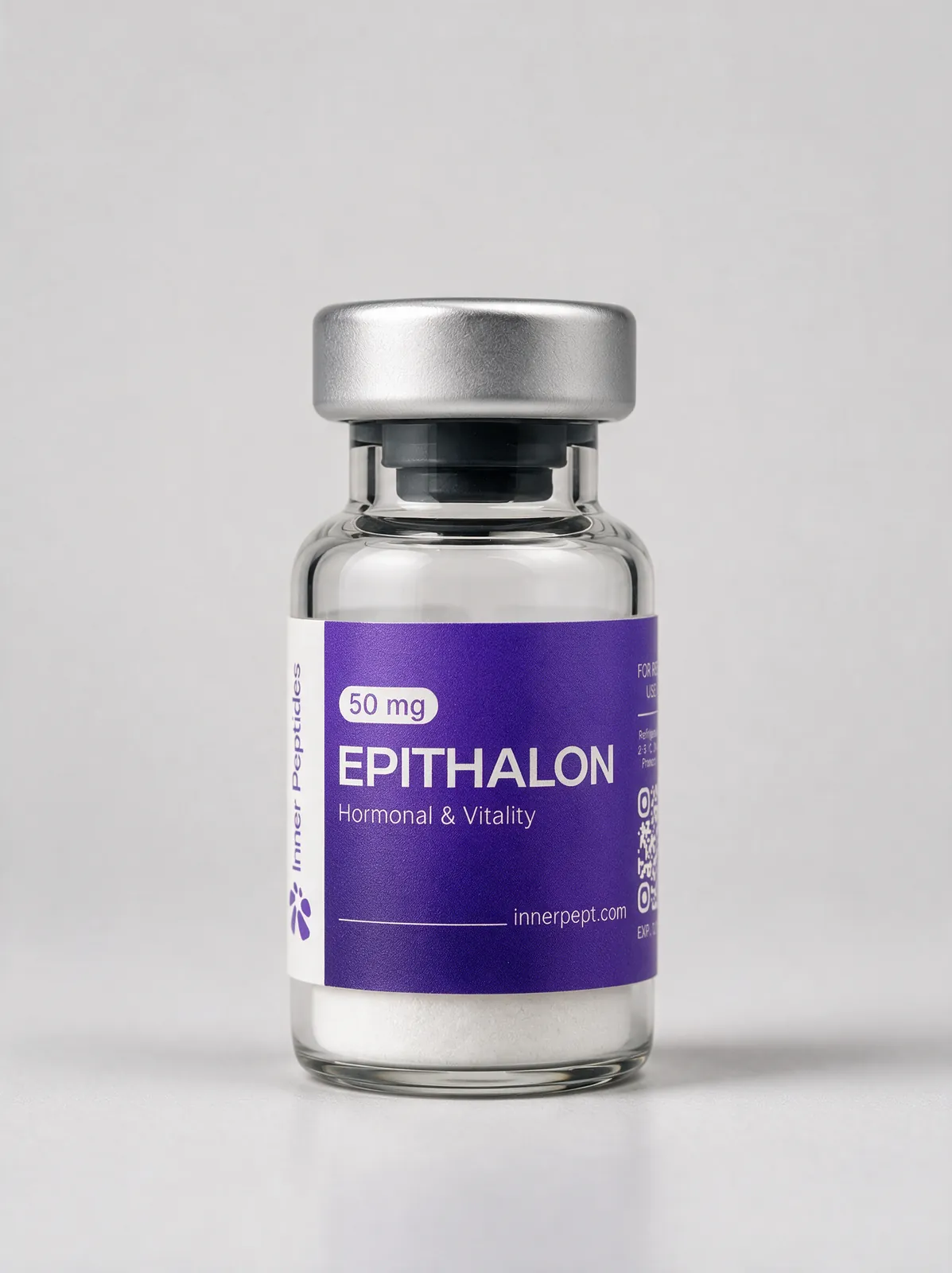
Epithalon is a very small peptide made in a lab. It's inspired by an extract from the pineal gland, a part of the brain that regulates melatonin and your body's internal clock. It's being studied for its connection to how cells age and to that internal clock.
How it might help you.
Epithalon is of interest to women 35 and older who think in decades rather than weeks — those drawn to cellular aging and circadian rhythm as a long-horizon question rather than a quick correction. Given how much of the research remains preclinical, it suits someone comfortable reading evidence honestly and deciding with a practitioner from there.
The figures above are the amount of lyophilized peptide in the vial — they are not a dose. Your protocol, timing, and duration are set one-to-one with a licensed practitioner based on your history and goals.
The technical details, if you're curious.
Everything below is optional: the science behind this product, for anyone who wants to read it.
What it is, in detail
Epithalon is a synthetic tetrapeptide — four amino acids in sequence, Ala-Glu-Asp-Gly, abbreviated AEDG. It was modeled on Epithalamin, an extract of the pineal gland, and developed at Vladimir Khavinson's St. Petersburg Institute of Bioregulation and Gerontology. The pineal gland governs melatonin release and the circadian timing beneath rest and repair. Epithalon belongs to a class of very short peptides studied as bioregulators: sequences brief enough to function as signals rather than as structural material, and researched for how they influence cellular behavior.
A pineal extract was the starting point, not a laboratory abstraction — Epithalon was built to echo a signal the body's own timekeeping gland already sends. That is the whole premise here: not installing a new instruction, but reintroducing a familiar one to systems whose rhythm and cellular maintenance tend to quiet with age. The signal is the body's; the peptide only repeats it.
How it works inside the body
Research on Epithalon centers on two connected paths: the telomerase enzyme that maintains chromosome ends, and the pineal-melatonin signaling that sets circadian timing. Most of this work is preclinical.
- A four-amino-acid signal. Epithalon is the sequence Ala-Glu-Asp-Gly, modeled on the pineal extract Epithalamin. At four amino acids it is studied as a bioregulator — a signal, not a structural protein.
- Telomerase activation. In human fetal fibroblasts in vitro, AEDG has been studied for its activation of telomerase — the enzyme that rebuilds the protective telomere caps at the ends of chromosomes.
- Telomere elongation in vitro. The same cell-culture line of research reports elongation of telomeres, and a 2025 independent replication at Brunel University London revisited that finding. This work sits in cells, not people.
- Circadian and melatonin signaling. Reflecting its pineal origin, Epithalon is also studied for circadian rhythm and melatonin regulation, alongside lifespan endpoints that have been examined in rodent models.
What the research looks at
- Is being studied for its activation of telomerase, the enzyme that maintains the telomere caps at the ends of chromosomes.
- Explored for a role in circadian and melatonin regulation, reflecting its origin in an extract of the pineal gland.
- May support the body's own maintenance signaling rather than introducing a foreign instruction — the sequence is modeled on a signal of pineal origin.
- Researched in rodent models for lifespan-related endpoints, part of a broader body of work on peptide bioregulators and cellular aging.
- Considered as one component of a long-horizon, practitioner-directed protocol rather than as a standalone intervention with a defined endpoint.
Where the research stands
The evidence base for Epithalon is largely preclinical: cell-culture work in human fetal fibroblasts, including an independent replication at Brunel University London in 2025, alongside rodent lifespan studies. Older Russian observational cohorts used the parent pineal extract rather than the synthetic peptide. No controlled human trial has measured telomere length before and after synthetic AEDG.
Technical specifications
Storage & handling
Before you start.
We don't publish a protocol. Epithalon is supplied as a 50 mg vial, and that figure is the total content of the vial — it is not a dose. Route, quantity, and schedule are worked out one-to-one with a licensed practitioner during consultation, based on your history and what else is already part of your care.
Any date we printed would be invention rather than evidence. The endpoints Epithalon is studied against — telomere biology, circadian timing — are not things you feel on a schedule, and much of that work has been done in cells and animals rather than in people. Setting expectations against your own starting point is work for consultation, not for a page like this.
Yes. The first step is someone licensed deciding whether there should be a second one — reviewing your health history, consider it against anything else already in your protocol, and confirm whether it is an appropriate fit. That conversation is where dose, route, and duration are decided — not on this page.
That has not been demonstrated. The telomerase and telomere-elongation findings come from cell culture — human fetal fibroblasts — including an independent replication at Brunel University London in 2025. No controlled human trial has measured telomere length before and after synthetic AEDG. We'd rather say that plainly than imply otherwise.
Epithalamin is the original pineal extract; Epithalon is the synthetic four-amino-acid sequence modeled on it. The distinction matters when reading the literature — the older Russian observational cohorts were conducted with the parent extract, not with synthetic AEDG. So those human observations do not transfer cleanly to the peptide itself.
Every Inner Peptides formula is independently tested before it ships, with a Certificate of Analysis available whenever you ask for it. Learn more about our testing standard.