NAD+ 500
A molecule your cells use to make energy.
Vial content, not a dose.
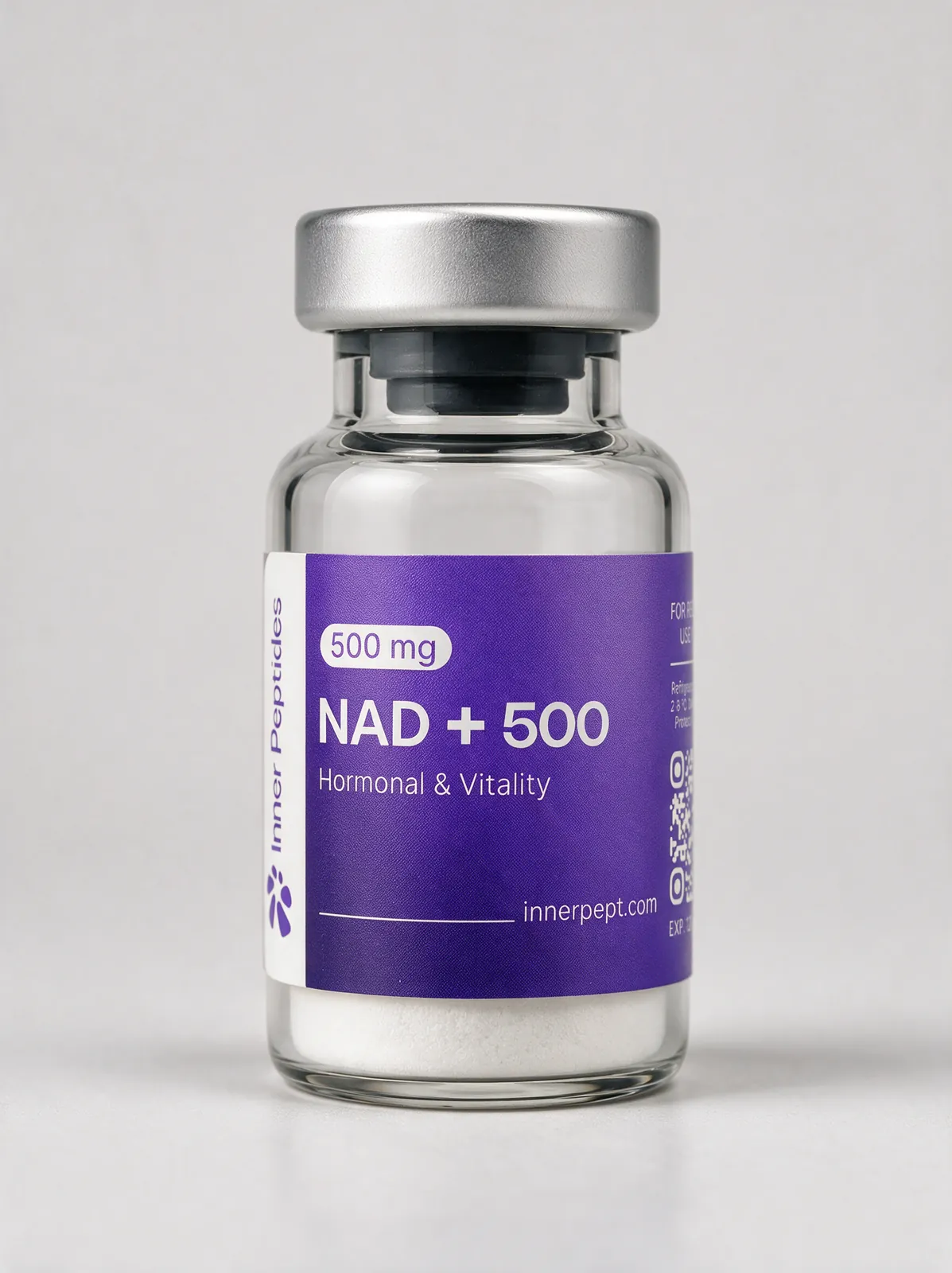
NAD+ is a molecule all your cells need to turn what you eat into energy and to repair themselves. Its levels tend to drop as you age. Researchers are studying whether replenishing it can support your energy and recovery — the evidence is still early, and we want to be upfront about that.
How it might help you.
NAD+ 500 tends to interest women 35 and older who are thinking at the level of cellular energy and maintenance rather than looking for an effect they'd feel the same day. It suits those who would rather understand what a molecule actually does — and where the evidence for it currently stops — before deciding whether it belongs in their protocol.
The figures above are the amount of lyophilized peptide in the vial — they are not a dose. Your protocol, timing, and duration are set one-to-one with a licensed practitioner based on your history and goals.
The technical details, if you're curious.
Everything below is optional: the science behind this product, for anyone who wants to read it.
What it is, in detail
NAD+ is a coenzyme rather than a peptide — the outlier in this catalog, and deliberately so. Structurally it is adenosine joined to nicotinamide riboside by a pyrophosphate bridge. Functionally it is among the most heavily used molecules in the cell: it carries electrons through the central reactions of energy metabolism, and it is consumed as raw material by enzymes that regulate and repair.
Most of this catalog works by reminding the body of a signal it already sends. NAD+ sits one layer beneath that: it is not a message but the currency those messages are paid in — the coenzyme the cell's own energy and repair machinery already runs on. Supplying it is not an instruction to do something new. It is restoring the material a system was already built to use.
How it works inside the body
NAD+ does not bind a receptor. It works as a substrate — passed between enzymes in three well-characterized roles, each one a step in metabolism or maintenance the cell already performs continuously.
- Redox electron carrier. In glycolysis, the TCA cycle, and oxidative phosphorylation, NAD+ accepts and releases electrons — the shuttle by which nutrients are converted into usable cellular energy.
- Sirtuin co-substrate. Sirtuins cannot act without NAD+; the enzyme consumes it as a required co-substrate. Available NAD+ is therefore a precondition for that regulatory family to function at all.
- PARP-mediated DNA repair. NAD+ also serves as the ADP-ribose donor that PARP enzymes draw on when carrying out DNA repair, linking the coenzyme pool directly to genomic maintenance.
What the research looks at
- Is studied as the electron carrier at the center of glycolysis, the TCA cycle, and oxidative phosphorylation — the cell's core energy pathways.
- May support the enzymes that depend on it, including sirtuins, which require NAD+ as a co-substrate in order to act at all.
- Is explored for its role in DNA repair, where it serves as the ADP-ribose donor that PARP enzymes draw on.
- Works as material the body's existing metabolic machinery already uses, rather than as a stimulant imposing an effect from outside.
- Is being studied for cellular energy and maintenance as part of a practitioner-directed plan, not as a standalone intervention.
Where the research stands
The biochemistry of NAD+ is well established. The case for injectable NAD+ is not. Human evidence remains minimal and preliminary — largely cell and animal work alongside small pilot studies. A 2020 systematic review characterized the results as promising yet still speculative, and we see no reason to describe them more confidently than that.
Technical specifications
Storage & handling
Before you start.
We don't publish a route, a schedule, or a dose. The 500 mg figure describes what the vial contains, not what anyone takes — two different numbers, and the distinction is the reason we publish one and not the other. Administration and protocol are confirmed with a licensed practitioner who has reviewed your history.
There isn't a timeline we can honestly publish. The honest answer is that human evidence for injectable NAD+ is thin enough that promising a window would mean inventing one. Which signals to watch — and how long to give them — is settled in consultation.
Yes. NAD+ 500 should be introduced only under a licensed practitioner who can review your health history, everything else you're taking, and whether this belongs in your plan at all. That last question is a real one, and it is theirs to answer rather than ours.
Because it follows the same logic. NAD+ is a coenzyme, structurally adenosine joined to nicotinamide riboside by a pyrophosphate bridge, not a signaling peptide. What it shares with the rest of the line is the premise: supplying something the body's own machinery already runs on, rather than introducing an outside effect.
Three things, all well characterized. It carries electrons through glycolysis, the TCA cycle, and oxidative phosphorylation. It is the required co-substrate for sirtuins. And it donates ADP-ribose to PARP enzymes during DNA repair. Established biochemistry is not the same as established clinical benefit, and we keep those two claims separate.
Every Inner Peptides formula is independently tested before it ships, with a Certificate of Analysis available whenever you ask for it. Learn more about our testing standard.