
MOTS-c
Studied for its role in your cells' energy.
Vial content — available presentations, not a dose.
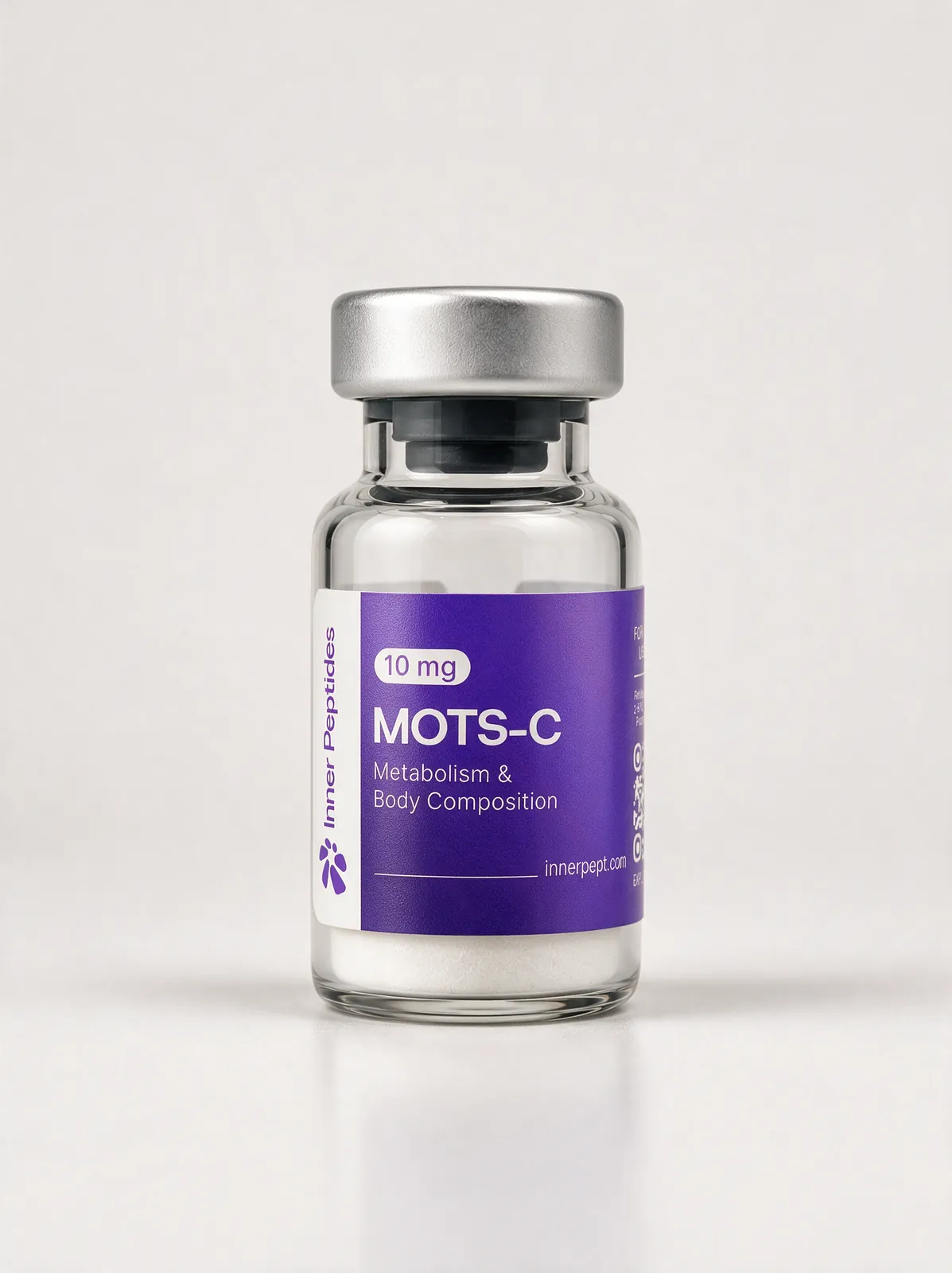
MOTS-c comes from your mitochondria, the parts of each cell that produce energy. It's a peptide, a very small protein, and studies describe it as part of how a cell signals how much energy it has. Your body makes it on its own, but less and less of it over the years.
How it might help you.
Most relevant to women 35+ who are tracking metabolic change — energy, glucose response, how the body shifts between fuel sources — and who prefer to understand a mechanism before adopting it. MOTS-c suits those comfortable with an emerging, still largely preclinical research picture, considered as one part of a plan built with a practitioner.
The figures above are the amount of lyophilized peptide in the vial — they are not a dose, and which presentation is appropriate is part of the conversation. Your protocol, timing, and duration are set one-to-one with a licensed practitioner based on your history and goals.
The technical details, if you're curious.
Everything below is optional: the science behind this product, for anyone who wants to read it.
What it is, in detail
MOTS-c is a mitochondrial-derived peptide: a 16-amino-acid sequence encoded within mitochondrial DNA rather than in the cell's nucleus. It was identified in 2015 by researchers at the University of Southern California. Because it originates inside the mitochondria, it is understood as part of how those organelles signal outward about the cell's energy state. Research describes it as an "exercise mimetic" — a molecule that engages pathways associated with metabolic demand. The amount the body makes on its own declines with age.
MOTS-c is not a message the body has to learn. It is written into mitochondrial DNA and has been part of how cells report their energy status since long before anyone named it. What changes with age is the volume, not the vocabulary — endogenous levels fall. Supporting this signal means asking an existing conversation to carry again, not installing a new one.
How it works inside the body
MOTS-c is described in research as an "exercise mimetic" — a signal that reaches the cell's energy-sensing machinery. The path runs from mitochondrial DNA to the folate cycle, to AMPK, and into the nucleus.
- Mitochondrial origin. MOTS-c is encoded within mitochondrial DNA rather than the cell's nucleus — a 16-amino-acid message the mitochondria themselves write. Endogenous levels decline with age.
- Folate-cycle accumulation. Research describes MOTS-c acting on the folate cycle, where the intermediate AICAR accumulates. That accumulation is the upstream event, not a separate stimulant effect layered on top.
- AMPK activation. Rising AICAR activates AMPK, the enzyme cells use to read energy status and shift how fuel is handled. This is MOTS-c's primary described action in the research.
- Nuclear translocation. Under metabolic stress, MOTS-c has been observed moving into the nucleus, where it participates in regulating gene expression — a slower, adaptive layer of the same signal.
What the research looks at
- May support the body's own energy-sensing signaling through AMPK, an existing cellular pathway, rather than acting as an external stimulant.
- Is being studied for its role in insulin sensitivity and glucose handling, largely in animal models rather than in established human protocols.
- Explored in preclinical research for lipid metabolism and resistance to weight gain, as one line of inquiry within broader metabolic science.
- Is studied for a possible relationship to physical performance and healthspan, reflecting its description in research as an exercise-mimetic signal.
- May be considered as one element of a practitioner-directed metabolic plan, alongside the nutrition, movement, and sleep work already in place.
Where the research stands
The evidence for MOTS-c is primarily preclinical — cell and animal studies. Human data exists but remains early and limited. Development has moved slowly, in part because the peptide is unstable, poorly bioavailable, and short-lived in circulation. Its evidence sits at the emerging tier, and the reasons are practical rather than theoretical.
Technical specifications
Storage & handling
Before you start.
We do not publish a route, dose, or schedule for MOTS-c. Vials are presented at 10 mg and 20 mg, and that figure describes the contents of the vial — it is not a dose. How the peptide is prepared and used is determined individually with a licensed practitioner during consultation, based on your history and goals.
There isn't a timeline we can honestly publish. Metabolic signaling shifts gradually, response varies by individual, and the research base here is early enough that any promised window would be invention rather than evidence. Your practitioner can identify which markers are worth tracking and revisit them with you over the course of the protocol.
Yes. Nothing here is designed to be started alone. A licensed practitioner should review your health history, consider anything else already part of your care, and decide whether it belongs in your plan at all. That conversation is where dose, format, and suitability are settled.
No, and the term is easy to misread. It describes an overlap in signaling — MOTS-c engages AMPK, one of the pathways physical activity also engages. Research on this comparison is preclinical. Nothing in it suggests the peptide substitutes for training, and Inner Peptides would not present it that way.
Partly for practical reasons. The peptide is difficult to work with — it is not especially stable, its bioavailability is low, and it clears quickly. Those properties have slowed formal study more than any question about the underlying biology. It is a real limitation, and it is why we place MOTS-c under emerging research.
Every Inner Peptides formula is independently tested before it ships, with a Certificate of Analysis available whenever you ask for it. Learn more about our testing standard.