
Tirzepatide
Works with two signals your body sends after you eat.
Vial content — available presentations, not a dose.
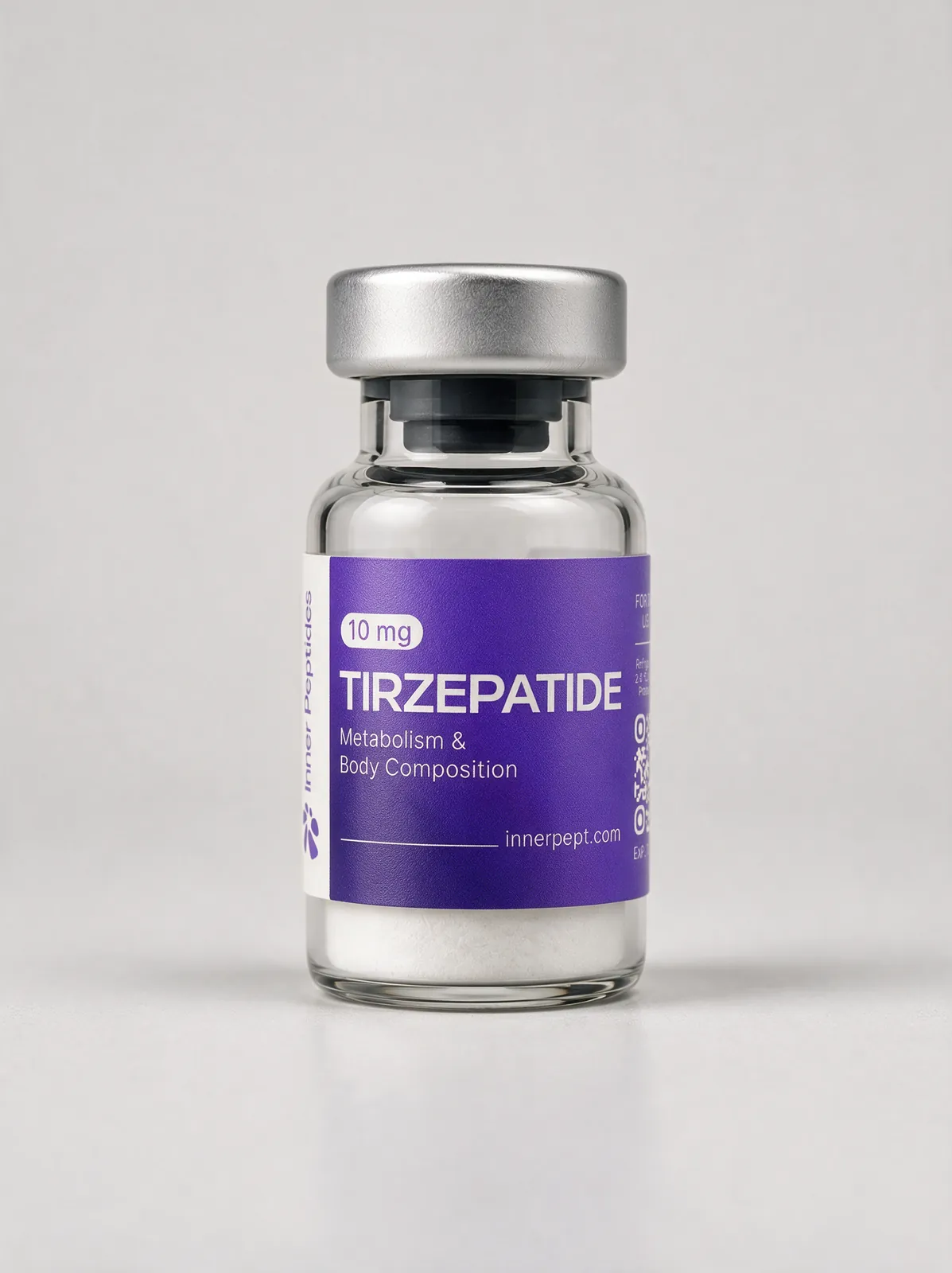
Tirzepatide is a small, lab-made protein that works with two signals your body sends after you eat. Your body uses them to decide how much insulin to release and when to make you feel full. It's among the most researched products in our catalog, with large studies in people with type 2 diabetes or obesity.
How it might help you.
Most relevant for women 35+ who are already working with a practitioner on the metabolic side of hormonal change — glucose response after meals, insulin sensitivity, shifting body composition — and who want an option with substantial clinical research behind it. It is considered against your own labs and history, never as a standard plan applied to everyone.
The figures above are the amount of lyophilized peptide in the vial — they are not a dose, and which presentation is appropriate is part of the conversation. Your protocol, timing, and duration are set one-to-one with a licensed practitioner based on your history and goals.
The technical details, if you're curious.
Everything below is optional: the science behind this product, for anyone who wants to read it.
What it is, in detail
Tirzepatide is a synthetic peptide designed as a dual agonist: a single molecule that engages two incretin receptors at once — the GIP receptor and the GLP-1 receptor. Both are incretin receptors — part of the signaling the body already uses to read a meal and respond to it. Rather than isolating one of those receptors, tirzepatide is built to engage both, treating the two arms of that system as connected rather than separate.
The incretin response is not something introduced from outside. Your body has always released these signals after eating, and has always used them to decide how much insulin to release and when to feel satisfied. Tirzepatide is studied for its work inside that existing conversation — reinforcing a signal already written into your physiology, not issuing a new instruction to replace it.
How it works inside the body
Tirzepatide is a dual agonist, which is a specific structural claim: one peptide chain shaped to bind two different incretin receptors. Here is the path that gives it its name.
- Dual receptor binding. A single molecule engages both the GIP receptor and the GLP-1 receptor, rather than acting on one incretin pathway and leaving the other untouched.
- GLP-1 receptor arm. Through the GLP-1 receptor, tirzepatide engages one of the two incretin pathways — the more familiar of the two, and the one most compounds in this category address on their own.
- GIP receptor arm. The GIP receptor supplies the second incretin input. Engaging it in the same molecule is what separates a dual agonist from a single-receptor one, and is the basis of the research interest.
- Coordinated metabolic signaling. Because both arms are engaged together, tirzepatide is studied for its role in glucose handling, appetite regulation, and body composition as one connected system rather than three separate targets.
What the research looks at
- Engages two incretin receptors — GIP and GLP-1 — in a single molecule, rather than addressing one arm of the post-meal signal in isolation.
- Is studied for its role in glucose handling and insulin signaling, the system the body already uses to manage what happens after a meal.
- Is explored for its relationship to appetite and satiety regulation as part of a broader metabolic picture, not as an isolated appetite intervention.
- Has been evaluated in large-scale controlled clinical programs, which places it among the better-characterized compounds in this category.
- Is approached as one component of a practitioner-designed protocol that accounts for labs, history, and body composition together.
Where the research stands
Tirzepatide is among the most thoroughly studied compounds in this catalog. It has been evaluated in two large controlled clinical programs — one in type 2 diabetes, one in obesity. That is a stronger evidence base than most peptides carry. It does not tell you how the compound will behave in your body, which is what consultation is for.
Technical specifications
Storage & handling
Before you start.
Administration is not something we set on this page. The 10 mg, 15 mg, and 30 mg figures describe how much compound a vial contains — they are not doses. Route, amount, and schedule are confirmed one-to-one with a licensed practitioner who has reviewed your metabolic markers, your history, and anything else already in your care.
We do not attach a timeline to it, and we would be inventing one if we did. Metabolic response depends on your starting point, on the protocol built around you, and on what else is in place — sleep, nutrition, movement. Your practitioner can tell you which markers are worth tracking and when to review them.
Yes. Tirzepatide acts directly on the incretin system, and it should only be introduced under a licensed practitioner who can review your health history, your current medications, and your metabolic markers before confirming whether it is appropriate and how it should be used. That review is not a formality; it is the protocol.
It means a single molecule engages two receptors rather than one — the GIP receptor and the GLP-1 receptor — instead of addressing a single incretin pathway. The research interest lies in what happens when both arms of the post-meal signal are engaged by the same molecule rather than treated separately.
No. Tirzepatide is studied as one input into a metabolic system that also responds to sleep, protein intake, resistance training, and stress. Practitioners generally position it inside that broader plan rather than as a substitute for it.
Every Inner Peptides formula is independently tested before it ships, with a Certificate of Analysis available whenever you ask for it. Learn more about our testing standard.