
Sermorelin
The shortest form of a signal your body already knows.
Vial content, not a dose.
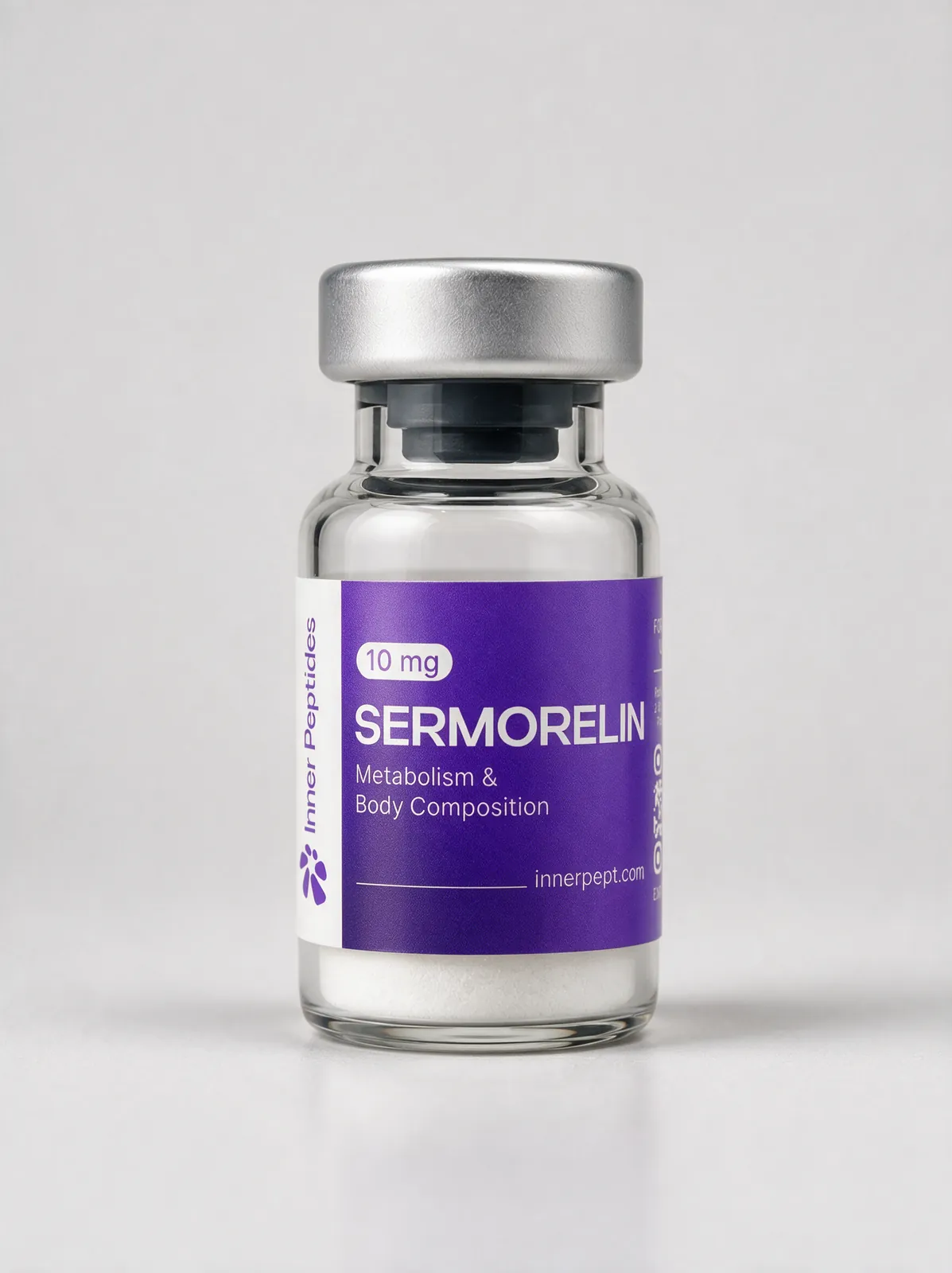
Sermorelin is a short, lab-made version of a message your body already sends. That message asks a small gland at the base of your brain to release growth hormone. It's not the hormone itself, but the signal that comes before it.
How it might help you.
Sermorelin is of interest to women 35 and older who are looking at energy, recovery, and body composition as part of one hormonal picture, and who would rather support the pituitary's own signaling than introduce growth hormone from outside it. It suits those who want to understand the mechanism before agreeing to a protocol, and who intend to be supervised throughout.
The figures above are the amount of lyophilized peptide in the vial — they are not a dose. Your protocol, timing, and duration are set one-to-one with a licensed practitioner based on your history and goals.
The technical details, if you're curious.
Everything below is optional: the science behind this product, for anyone who wants to read it.
What it is, in detail
Sermorelin is a synthetic, C-terminally amidated peptide of 29 amino acids, corresponding to the biologically active 1–29 fragment of human growth hormone-releasing hormone — the shortest sequence that still carries the full GHRH signal. It is not growth hormone itself. It is the instruction that precedes it: the message the hypothalamus sends to the pituitary gland, reproduced in its minimal functional form.
Growth hormone release was never meant to be constant. The hypothalamus speaks to the pituitary in pulses; the pituitary answers in kind, and negative feedback decides when the exchange stops. Sermorelin does not supply the hormone and does not replace that exchange. It reproduces the opening line of it — the shortest form of a message the body already knows how to send.
How it works inside the body
Sermorelin acts at the top of the growth hormone axis rather than at its end point. It carries the same instruction the hypothalamus sends, and reaches the pituitary through the receptor built to receive it.
- GHRH receptor binding. Sermorelin binds the GHRH receptor on pituitary somatotrophs — the same site the hypothalamus's own growth hormone-releasing hormone occupies when it signals the gland.
- cAMP signaling. Receptor engagement raises intracellular cAMP inside the somatotroph — the second messenger that carries the instruction forward into growth hormone synthesis and release.
- Pulsatile release. Growth hormone is released in the pituitary's own pulsatile pattern — in pulses, on the gland's existing rhythm, rather than as a flat continuous supply from outside.
- Feedback preserved. Because the signal enters upstream at the pituitary, the axis's negative feedback stays intact — the body keeps its own capacity to moderate how much is released.
What the research looks at
- Acts upstream at the pituitary's GHRH receptor rather than introducing growth hormone from outside the body, leaving the release itself to the gland.
- Is studied for its role in stimulating growth hormone release in the body's own pulsatile pattern rather than as a continuous supply.
- Preserves the negative feedback built into the growth hormone axis, so the body retains its own control over how much is released.
- Represents the shortest fully functional fragment of human GHRH, a minimal version of a signal the body already produces on its own.
- Considered within a practitioner-directed plan that reads the hormonal picture as a whole, rather than as a standalone intervention.
Where the research stands
Sermorelin has a genuine clinical history: it was developed with a full research dossier, originally as a diagnostic agent for measuring the pituitary's growth hormone secretory capacity, and was used in pediatric growth hormone deficiency. That is where its human evidence sits. Its use for long-term vitality has not been established to the same standard, and is not presented here as though it were.
Technical specifications
Storage & handling
Before you start.
We don't publish a route, a dose, or a schedule for Sermorelin. The 10 mg figure on this page is the content of the vial, not an amount to take. Administration, dosing, and protocol length are confirmed one-to-one with a licensed practitioner who has seen your history and your labs.
We don't attach a timeline to this. Growth hormone signaling operates on the body's own rhythm, and individual response varies with baseline pituitary function and everything else in your protocol. Setting expectations against your own starting point is work for consultation, not for a page like this.
Yes. Sermorelin acts directly on the growth hormone axis, which means it belongs in a supervised protocol rather than a self-directed one. A licensed practitioner reviews your health history, considers what else you're already taking, and confirms whether it's an appropriate fit before anything begins.
Supplying growth hormone directly does not involve the pituitary at all. Sermorelin works one step earlier, at the GHRH receptor on pituitary somatotrophs, so release follows the gland's own pulsatile pattern and the axis's negative feedback stays in place. It is a prompt to the gland rather than a substitute for it.
Human GHRH is a longer molecule; its biologically active region sits in the first 29 amino acids. Sermorelin is exactly that fragment, amidated at the C-terminus — the shortest sequence that still carries a complete GHRH signal. Nothing is added to the molecule. What's left out is what sits outside the active region.
Every Inner Peptides formula is independently tested before it ships, with a Certificate of Analysis available whenever you ask for it. Learn more about our testing standard.