
Tesamorelin
Acts on the gland that releases your growth hormone.
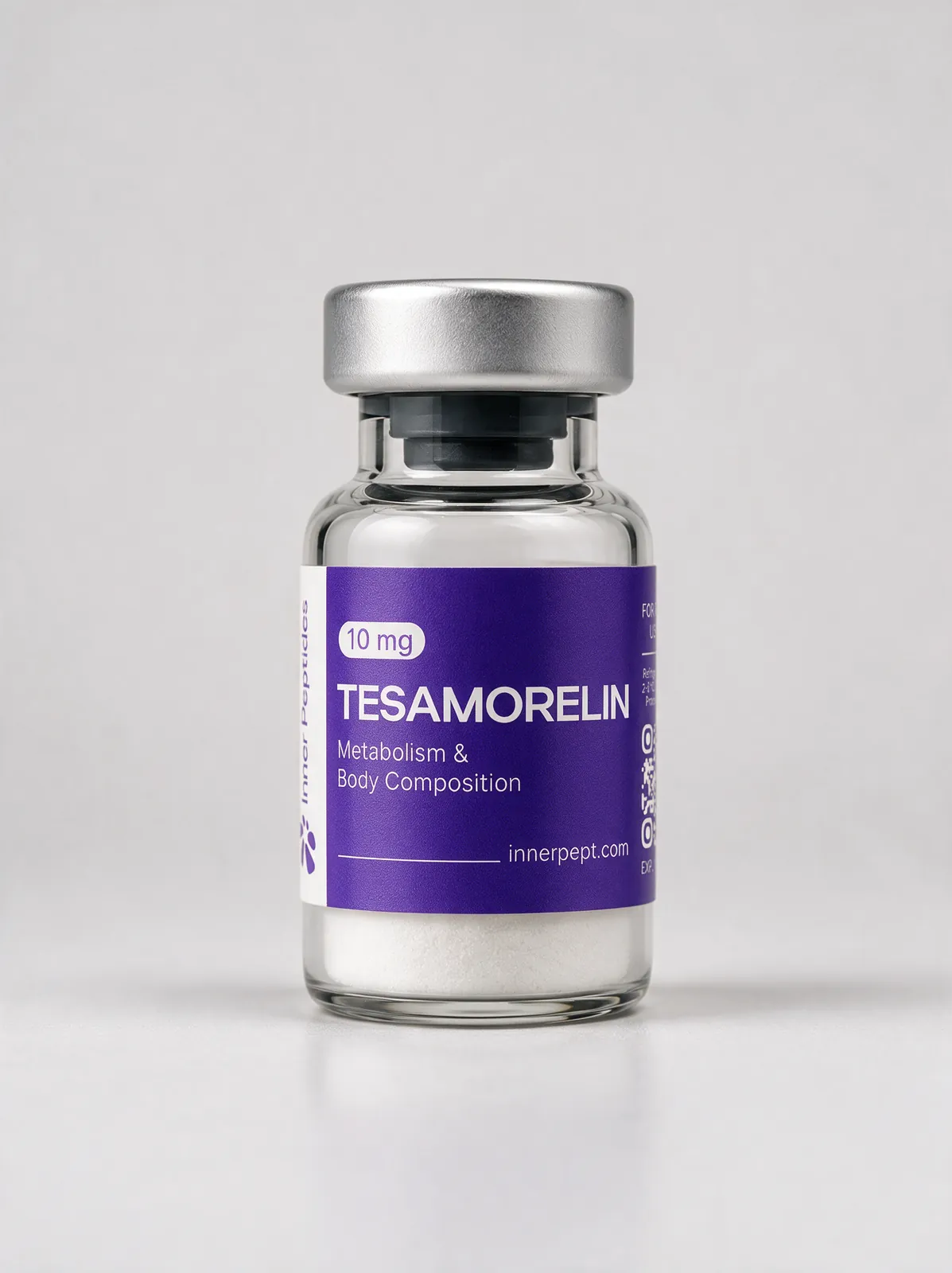
Vial content, not a dose.
Tesamorelin mimics a message your brain already sends to a small gland, telling it to release growth hormone. It's a sturdier version of that message, one that doesn't break down as quickly. It doesn't contain growth hormone — it asks that gland to release the growth hormone your body already makes.
How it might help you.
Tesamorelin is of interest to women 35 and older who are noticing changes in body composition — particularly abdominal fat distribution — alongside the broader hormonal shifts of this stage, and who would rather support the gland that regulates growth hormone than supply the hormone directly. It belongs inside a supervised protocol, not on its own.
The figures above are the amount of lyophilized peptide in the vial — they are not a dose. Your protocol, timing, and duration are set one-to-one with a licensed practitioner based on your history and goals.
The technical details, if you're curious.
Everything below is optional: the science behind this product, for anyone who wants to read it.
What it is, in detail
Tesamorelin is a stabilized synthetic analog of human growth hormone-releasing hormone — the full 44-amino-acid GHRH sequence, carrying a trans-3-hexenoic acid group at its N-terminus. That single structural addition is the point: it resists the enzyme DPP-IV, which would otherwise break the native hormone down quickly. Tesamorelin does not supply growth hormone. It carries the same instruction the hypothalamus already sends to the pituitary, in a form built to survive long enough to deliver it.
Growth hormone release was never meant to be a constant supply — the hypothalamus sends GHRH in pulses, and the pituitary answers in kind. Tesamorelin binds that same receptor and leaves the rhythm intact. Nothing is overridden and nothing is replaced; the original instruction is simply carried to the gland that has always known how to respond to it.
How it works inside the body
Tesamorelin acts one step upstream of growth hormone itself, on the GHRH signaling path that runs from hypothalamus to pituitary. Four structural and receptor-level details explain how that instruction survives and where it lands.
- DPP-IV resistance. The trans-3-hexenoic acid modification at the N-terminus shields the 44-amino-acid chain from DPP-IV, the enzyme that rapidly clears native GHRH. The signal stays intact on its way to the pituitary.
- GHRH receptor binding. Tesamorelin binds the GHRH receptor on pituitary somatotrophs — the same receptor the body's own hypothalamic GHRH occupies. No new pathway is introduced; an existing one is engaged.
- Endogenous GH release. Receptor engagement stimulates the somatotroph to release growth hormone the body has produced itself. Nothing exogenous is administered — the gland supplies the hormone, prompted rather than bypassed.
- Preserved pulsatility. Because release originates at the pituitary rather than from an outside supply, the natural pulsatile pattern of growth hormone secretion is preserved rather than flattened into continuous exposure.
What the research looks at
- Is studied for its role in prompting the pituitary's own growth hormone release, rather than introducing growth hormone from outside the body.
- May support the body's natural pulsatile rhythm of growth hormone secretion, since the signal acts upstream at the gland rather than replacing the hormone itself.
- Has been evaluated in controlled Phase 3 clinical research examining visceral adipose tissue — abdominal fat stored around the organs — in a specific patient population.
- Is explored for its relevance to body composition as growth hormone output changes with age, always within a supervised, individually built protocol.
- Built on the body's own GHRH sequence, with a single structural modification that resists enzymatic breakdown rather than changing the signal being sent.
Where the research stands
Tesamorelin has been studied in a large-scale Phase 3 clinical program, which is more human evidence than most peptides carry. That work was conducted in a narrow population — adults with HIV-associated lipodystrophy — and examined visceral fat in that context. Its relevance to general body composition in women has not been established to the same standard.
Technical specifications
Storage & handling
Before you start.
Tesamorelin is prepared from a lyophilized vial containing 10 mg — that figure is the vial content, not a dose. We don't publish a standard protocol, because route, amount, and schedule depend on your history, your labs, and what else is already part of your care. All of it is confirmed with a licensed practitioner during consultation.
We won't promise one. Growth hormone signaling is a rhythm rather than a switch, and response depends on your baseline output, age, and the rest of the protocol built around you. Your practitioner can name the markers that matter in your case and decide when to look at them again.
Yes. Tesamorelin acts directly on the growth hormone axis at the level of the pituitary, which means it should only be introduced by a licensed practitioner who can review your health history, your current medications, and your hormonal picture, and then decide whether it belongs in your protocol at all.
Growth hormone given directly bypasses the pituitary and arrives as a continuous outside supply. Tesamorelin works one step earlier: it binds the GHRH receptor on the pituitary, and the gland releases its own growth hormone in its own pulsatile pattern. The rhythm stays the body's, which is the distinction that matters here.
It covers a specific population. The Phase 3 work was carried out in adults with HIV-associated lipodystrophy and looked at visceral fat in that setting. That is real, controlled human research, and it is also narrower than the way this compound is often discussed. We'd rather you know the difference before you consider it.
Every Inner Peptides formula is independently tested before it ships, with a Certificate of Analysis available whenever you ask for it. Learn more about our testing standard.