
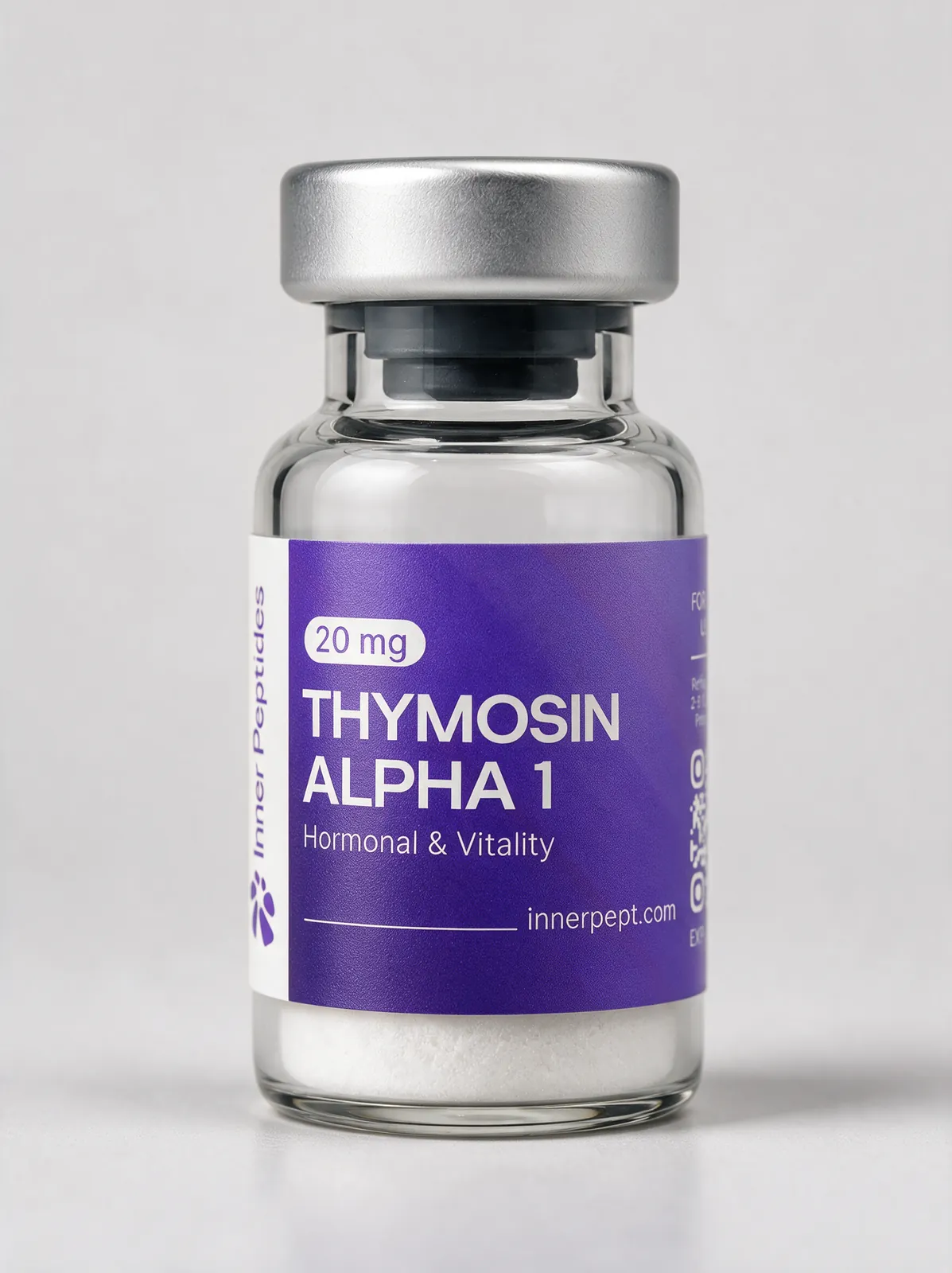
Thymosin Alpha 1
Estudiado por su papel en el equilibrio de tus defensas.
Contenido del vial, no una dosis.
Es una copia de un pequeño fragmento de una proteína que tu propio cuerpo fabrica. Se descubrió en el timo, la glándula donde tus defensas aprenden a distinguir qué es parte de ti y qué no. Se estudia por su papel en ajustar tus defensas, más que en acelerarlas.
En qué te podría ayudar.
Es más relevante para mujeres de 35 años en adelante que están atentas a su resiliencia inmunitaria junto con los cambios hormonales y metabólicos de esta etapa: una recuperación más lenta de las enfermedades comunes, o la sensación de que las defensas del cuerpo responden de forma distinta a como lo hacían antes. Encaja con quien quiere entender un mecanismo y evaluarlo con un profesional de la salud, en lugar de darlo por sentado.
Las cifras de arriba son la cantidad de péptido liofilizado que contiene el vial — no son una dosis. Tu protocolo, tiempos y duración se definen uno a uno con un profesional de la salud licenciado, a partir de tu historia y tus objetivos.
Los detalles técnicos, por si te interesan.
Todo lo que sigue es opcional: la ciencia detrás de este producto, para quien quiera leerla.
Qué es, en detalle
Thymosin Alpha 1 es un péptido de 28 aminoácidos, acetilado en uno de sus extremos, que deriva de una proteína precursora más grande llamada protimosina alfa. Se aisló por primera vez del timo de ternero en 1977 — el timo es la glándula donde los linfocitos T aprenden qué pertenece al cuerpo y qué no. Más que empujar al sistema inmunitario en bloque, se estudia como un modulador: un péptido que participa en cómo las células inmunitarias maduran, se comunican y calibran la magnitud de su respuesta.
Thymosin Alpha 1 no es un estimulante ajeno al cuerpo. Proviene de la protimosina alfa, una proteína que el propio cuerpo fabrica, y la investigación lo describe como algo que recalibra: restaura el equilibrio entre las distintas ramas de la respuesta inmunitaria en lugar de forzar una de ellas. Esa distinción es la premisa sobre la que se apoya el resto de este catálogo: una señal que vuelve a la conversación, no una orden nueva.
Cómo funciona por dentro
Casi todo lo que se sabe sobre cómo funciona este péptido empieza en un solo receptor de las células dendríticas: las células que deciden a qué presta atención el sistema inmunitario, y con cuánta intensidad.
- Unión a TLR9. Thymosin Alpha 1 señaliza a través de TLR9 en las células dendríticas, un sensor de la inmunidad innata que determina si estas células escalan una respuesta ante lo que encuentran, y de qué manera.
- Relevo de MyD88 a IRF7. Más abajo en la vía, la señal recorre el adaptador MyD88 hasta IRF7 y de ahí a IDO: el relevo intracelular que traduce la unión al receptor en una respuesta coordinada y regulada, no en una indiscriminada.
- Maduración de las células dendríticas. Esa señalización se describe como un refuerzo de la maduración de las células dendríticas y de la citotoxicidad de las células natural killer: dos de las primeras líneas de respuesta del sistema inmunitario, afinadas en lugar de sobreexcitadas.
- Calibración Th1/Th2. Más adelante, la investigación describe efectos sobre la maduración de los linfocitos T y sobre el equilibrio Th1/Th2: el peso relativo de dos ramas de la respuesta adaptativa, ajustado en lugar de amplificado.
Lo que estudia la investigación
- Se estudia por su papel en la modulación inmunitaria: la calibración de una respuesta, más que un empuje general hacia más actividad inmunitaria en todos los frentes.
- Podría apoyar la maduración y la señalización de las células dendríticas, las células que marcan la dirección y la magnitud de una respuesta inmunitaria.
- Se explora por su relación con el equilibrio Th1/Th2, la proporción que la investigación asocia con una reacción inmunitaria mesurada y no exagerada.
- Se ha estudiado en hepatitis B y C crónicas, en el apoyo inmunitario durante el tratamiento oncológico, en sepsis y en la recuperación posviral: un registro de investigación clínica inusualmente amplio.
- Se considera un elemento más dentro de un plan dirigido por un profesional de la salud que ya toma en cuenta tu panorama de salud completo, no una solución inmunitaria por sí sola.
En qué punto está la investigación
Thymosin Alpha 1 tiene uno de los registros de investigación en humanos más sólidos de este catálogo: décadas de ensayos clínicos controlados, entre ellos un programa de Fase 3 en hepatitis B crónica, además de estudios en esquemas combinados para hepatitis C, en sepsis y en el apoyo inmunitario durante el tratamiento oncológico. Fuera de esos escenarios la evidencia se adelgaza: el uso amplio para la resiliencia inmunitaria no está establecido con el mismo rigor.
Ficha técnica
Conservación y manejo
Antes de empezar.
Aquí se ofrece en un vial de 20 mg: esa cifra es el contenido del vial, no una dosis. No publicamos un protocolo; la vía, la cantidad y la frecuencia se determinan caso por caso con un profesional de la salud licenciado, a partir de tu historia clínica y de lo que ya forma parte de tu cuidado.
No le ponemos un plazo. La señalización inmunitaria no es algo que se sienta cambiar de una hora a otra, y la respuesta depende de tu punto de partida, del resto de tu protocolo y de lo que dio origen a la conversación. Ese criterio le corresponde a quien está leyendo tus análisis, no a nosotros.
Sí. Thymosin Alpha 1 actúa sobre la regulación inmunitaria, así que hay que valorarlo frente a tu historia completa: lo que ya tomas y lo que ya está bajo seguimiento médico. Un profesional de la salud licenciado revisa ese panorama y confirma si esto tiene lugar en tu plan antes de comenzar.
La investigación lo plantea como modulación más que como estimulación. A través de la señalización de TLR9 en las células dendríticas se describe como algo que recalibra la maduración de los linfocitos T y el equilibrio Th1/Th2: ajusta la proporción de una respuesta en lugar de subirle el volumen. Esa distinción importa, y es la razón por la que se habla de este péptido en términos de equilibrio y no de refuerzo.
Deriva de la protimosina alfa, una proteína que el cuerpo produce, y se aisló por primera vez de tejido del timo en 1977. La versión que se usa en la terapia con péptidos se sintetiza con esa misma estructura de 28 aminoácidos, acetilada. No es una molécula nueva inventada en un laboratorio: es una copia de una señal que ya está en el repertorio del cuerpo.
Cada fórmula de Inner Peptides se analiza de forma independiente antes de enviarse, con un Certificado de Análisis disponible si lo pides. Conoce más sobre nuestro estándar de análisis.