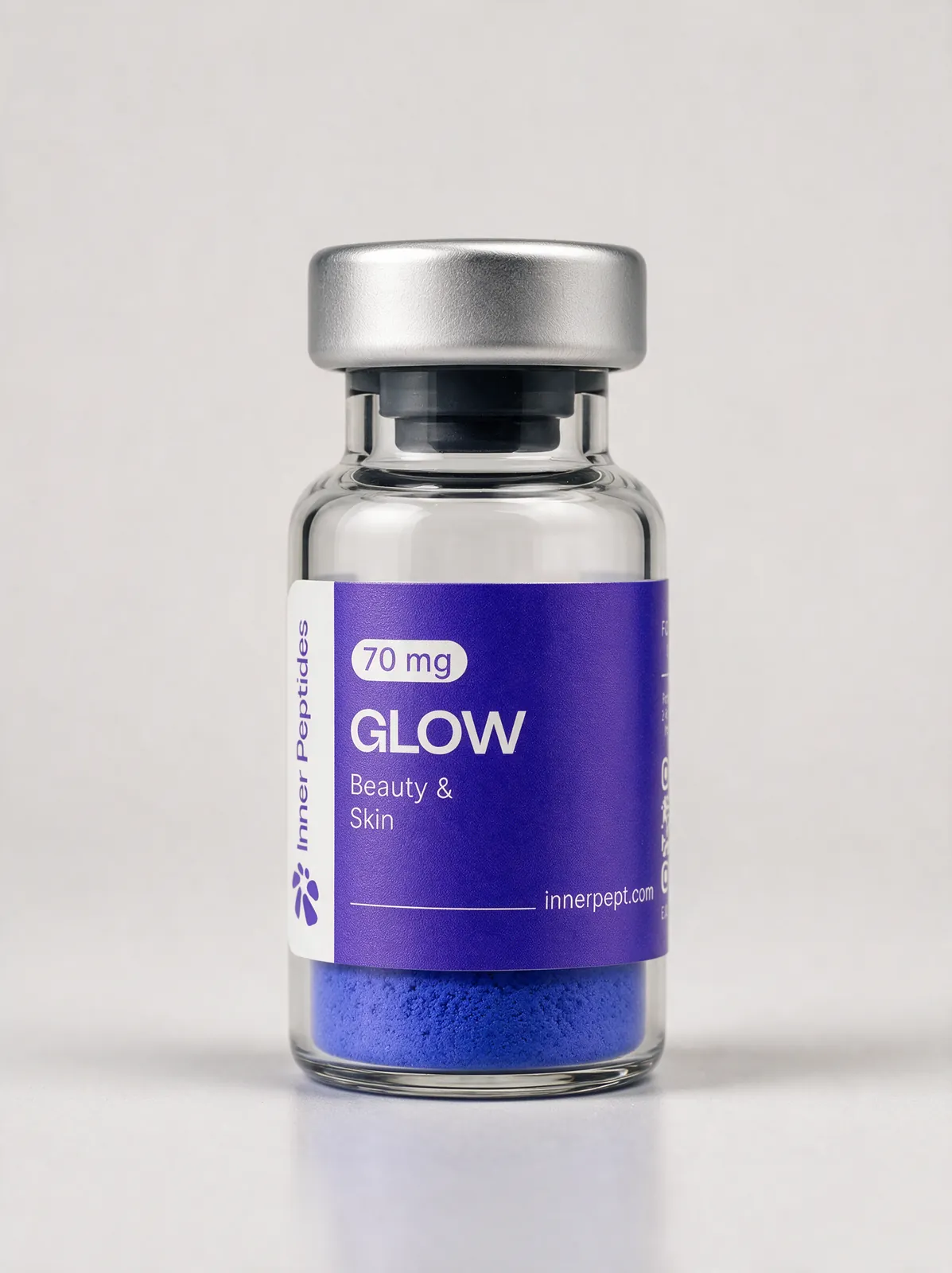

KLOW
Cuatro péptidos en estudio: piel, reparación e inflamación.
Contenido del vial, no una dosis.
KLOW junta cuatro péptidos en un solo frasco. Es la fórmula de GLOW con un ingrediente más, KPV, un pedacito de una sustancia que tu cuerpo ya produce. La idea parte de dos preguntas: cómo se reparan la piel y los tejidos, y qué pasa con esa reparación cuando la inflamación dura más de la cuenta.
En qué te podría ayudar.
KLOW puede interesar a mujeres de 35 años en adelante que notan cambios en la estructura de la piel o en su capacidad de recuperarse, junto con una recuperación general más lenta, y que sospechan que el tono inflamatorio forma parte del cuadro y no es un asunto aparte. Se ubica dentro de una evaluación más amplia — hormonal, metabólica, nutricional — hecha junto a un profesional de la salud licenciado, nunca en lugar de él.
Las cifras de arriba son la cantidad de péptido liofilizado que contiene el vial — no son una dosis. Tu protocolo, tiempos y duración se definen uno a uno con un profesional de la salud licenciado, a partir de tu historia y tus objetivos.
Qué hay realmente en el vial.
Es una fórmula combinada: cada cifra es la parte de ese componente dentro del vial.
Ver compuesto →10 mg BPC-157
Ver compuesto →10 mg TB-500
Ver compuesto →10 mg KPV
Ver compuesto →
Los detalles técnicos, por si te interesan.
Todo lo que sigue es opcional: la ciencia detrás de este producto, para quien quiera leerla.
Qué es, en detalle
KLOW es una mezcla liofilizada de cuatro péptidos: GHK-Cu, BPC-157, TB-500 y KPV, reunidos en un solo vial. Toma la base de tres péptidos de GLOW y le suma KPV, un fragmento corto de una molécula de señalización que el cuerpo ya produce para ayudar a regular el tono inflamatorio. El resultado es una formulación construida alrededor de dos preguntas relacionadas en lugar de una: cómo se reconstruye el tejido, y qué ocurre con esa reconstrucción cuando la señalización inflamatoria permanece encendida más tiempo del que debería.
Cada componente de esta mezcla corresponde a algo que el cuerpo ya pone en marcha: un tripéptido de cobre presente en el plasma, un fragmento de una proteína gástrica, el segmento de unión a actina de una proteína presente en la mayoría de las células humanas y el extremo final de una molécula de señalización que el cuerpo ya produce para ayudar a regular el tono inflamatorio. KLOW no introduce una instrucción nueva. Vuelve a reunir señales que siempre formaron parte de la secuencia de reparación.
Cómo funciona por dentro
KLOW superpone cuatro señales peptídicas sobre una misma secuencia de reparación — construcción de la matriz, aporte sanguíneo, migración celular y tono inflamatorio — , y cada una actúa sobre una vía molecular distinta, no sobre una compartida.
- Señalización cobre–matriz. GHK-Cu, un tripéptido quelado con cobre(II), se estudia por la síntesis de colágeno y elastina, la remodelación de la matriz extracelular y la señalización angiogénica mediante el aumento de bFGF y VEGF.
- Señalización angiogénica de reparación. BPC-157 se ha investigado en modelos animales por la angiogénesis y la reparación de tejidos blandos, actuando a través de la señalización del óxido nítrico y de las vías VEGFR2–Akt–eNOS y FAK–paxilina.
- Migración celular dependiente de actina. TB-500 es la región de unión a actina de la timosina beta-4; se estudia en modelos animales por la migración celular y la menor fibrosis mediante la regulación de la actina, Akt/mTOR y el aumento de VEGF y angiopoyetina-1.
- Bloqueo nuclear de NF-κB. KPV compite con la importina-alfa por la señal de localización nuclear de p65/RelA de NF-κB, con lo que bloquea la translocación nuclear y suprime TNF-α, IL-1β e IL-6; además inhibe la señalización de MAPK.
Lo que estudia la investigación
- Reúne cuatro péptidos estudiados por separado por funciones distintas dentro de la reparación de tejidos — síntesis de matriz, señalización vascular, migración celular y regulación inflamatoria — , y no por una única vía compartida.
- GHK-Cu se estudia, sobre todo in vitro y en modelos tópicos, por la síntesis de colágeno y elastina y la remodelación de la matriz extracelular en la piel.
- KPV es el componente que distingue a KLOW de GLOW; se explora por su papel en atenuar la señalización inflamatoria a nivel celular, más que en suprimirla por completo.
- Podría apoyar la propia secuencia de reparación del cuerpo en situaciones donde la inflamación sostenida parece ir por delante de la reconstrucción a la que debería acompañar.
- Se plantea como un elemento dentro de un protocolo dirigido por un profesional, no como una respuesta única a inquietudes de piel, cabello o recuperación.
En qué punto está la investigación
La evidencia disponible es preclínica y mecanicista, y corresponde a los componentes por separado, no a la mezcla. Ningún estudio revisado por pares ha evaluado la formulación KLOW como conjunto. BPC-157, TB-500 y KPV se apoyan en trabajo en animales y in vitro; los datos más sólidos de GHK-Cu son tópicos y dermatológicos, no sistémicos.
Ficha técnica
Conservación y manejo
Antes de empezar.
El formato y el protocolo de KLOW no se publican de forma genérica. Los 80 mg del vial describen su contenido liofilizado, no una dosis. La forma de uso, la cantidad y la frecuencia se establecen de manera individual, en consulta con un profesional de la salud licenciado que valorará tu historia clínica y tus objetivos antes de definir nada.
No le vamos a poner un plazo. La estructura de la piel, la reparación de tejidos y el tono inflamatorio avanzan cada uno en su propio tiempo, y esos tiempos cambian de una persona a otra. Qué conviene observar, y durante cuánto, es una pregunta para el profesional que conoce tu punto de partida.
Sí. KLOW solo debería introducirse bajo la guía de un profesional de la salud licenciado, capaz de revisar tu historia clínica, considerarla frente a todo lo que ya forma parte de tu cuidado y decidir si una mezcla de cuatro péptidos es siquiera el punto de partida adecuado para ti.
GLOW combina GHK-Cu con BPC-157 y TB-500. KLOW conserva esa base y suma KPV, un tripéptido estudiado por la inhibición de la señalización de NF-κB. La diferencia es una cuarta dimensión — la regulación inflamatoria — superpuesta a las señales de reparación que ya trae la base de tres péptidos. Si esa adición es relevante para ti, es una pregunta para la consulta.
KPV es el tripéptido C-terminal de la alfa-MSH, los residuos 11 a 13. La investigación indica que conserva buena parte de la actividad antiinflamatoria de la molécula original sin la señalización relacionada con la pigmentación, y que actúa dentro de la célula y no a través de los receptores de melanocortina. Tu profesional de la salud puede explicarte esa distinción con más detalle.
Cada fórmula de Inner Peptides se analiza de forma independiente antes de enviarse, con un Certificado de Análisis disponible si lo pides. Conoce más sobre nuestro estándar de análisis.